Don't Die Updates
My First Month with WHOOP: What I Learned About Sleep, Strain, and Recovery

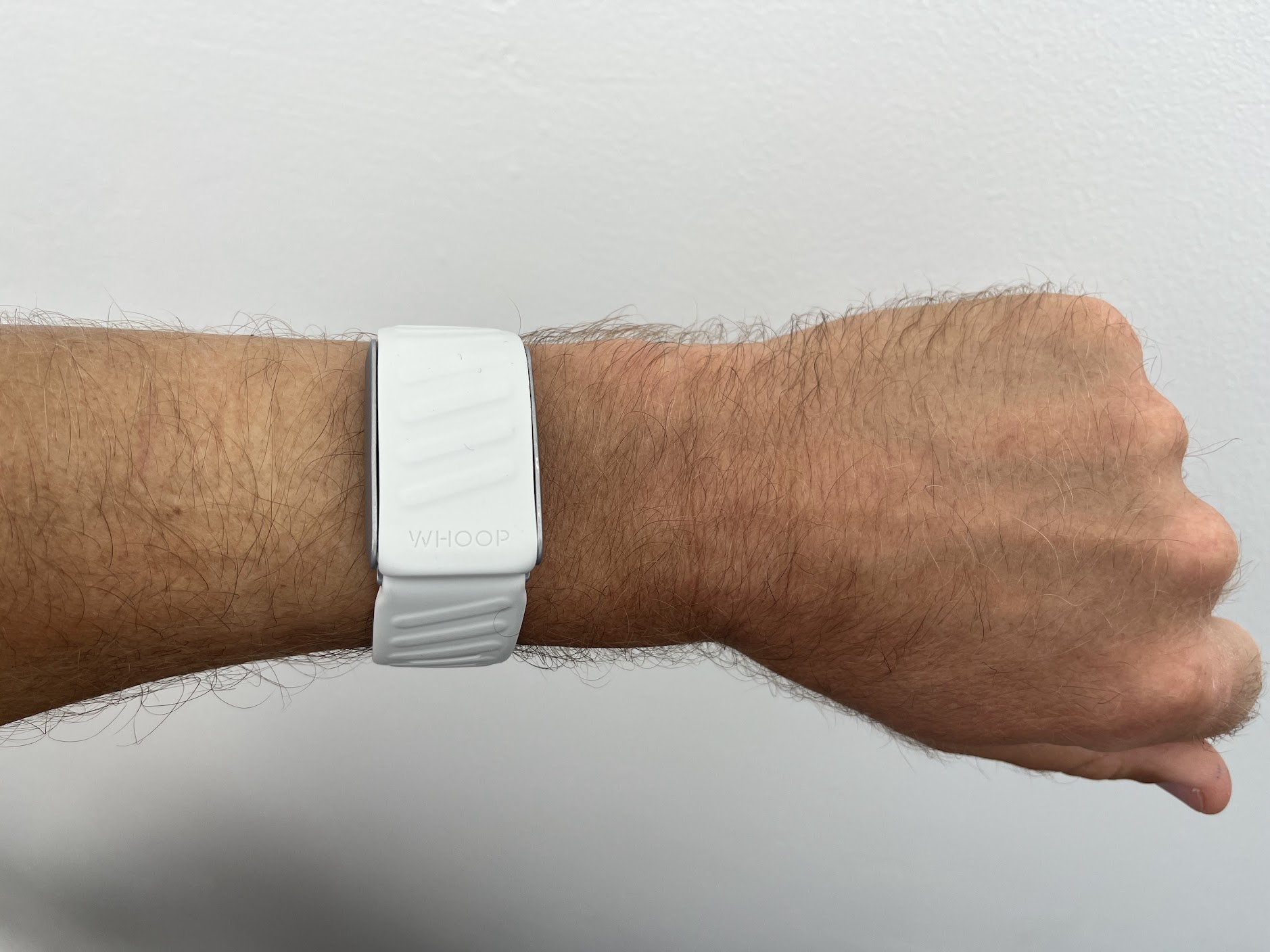
Tracking my first full month with WHOOP gave me eye-opening insights into how I train, recover, and why I desperately need to improve my sleep.
Today, I’m sharing my first real look at what WHOOP has revealed about my body, my training, and where I need to improve. I started wearing the WHOOP 4.0 when it arrived on January 10th. For the rest of the month, it tracked everything from heart rate variability, skin temperature, and resting heart rate to strain, recovery, and sleep quality. It didn’t take long to realize that while I push my body hard, I’m not always doing it smart. Spoiler alert: my sleep needs some serious work.
Strain: I Bring the Effort
If there’s one thing I can pat myself on the back for, it’s showing up. WHOOP uses a metric called “strain” to measure how much cardiovascular load you take on each day. For January, I averaged a pretty solid 15.7 strain. That means I was regularly hitting moderate to strenuous levels of effort in my workouts.
Here’s how my weekly strain broke down:
- Most intense day: Tuesday (17.5 average strain)
- Least intense day: Thursday (13.2 average strain)
- Most frequent activity: Running (21 sessions with a 14.1 average strain)
- Most time spent: Golf (12+ hours across 5 sessions)
I trained 36 times in 21 days, logging over 35 hours of activity. Clearly, I like to move. But that effort doesn’t mean much without proper recovery.
Recovery: The Missing Piece
WHOOP’s recovery score measures how ready your body is to perform, using heart rate variability, resting heart rate, and sleep as key indicators. For January, my recovery was all over the place.
Green recovery days (optimal readiness) were rare. Red and yellow days popped up more than I’d like. This tells me I’m often overreaching. I’m pushing harder than my body is ready for. While it’s great to be motivated, it’s smarter to align effort with recovery.
One of the clearest signals? My HRV (Heart Rate Variability) was just 25 ms in January. For context, a higher HRV generally means better recovery and resilience. My resting heart rate averaged 50 bpm, which is good, but the low HRV hints at stress and under-recovery.
Sleep: Must. Do. Better.
Let’s just say this, if WHOOP handed out report cards for sleep, mine would say, “Needs improvement.”
WHOOP calculates your sleep need and compares it to how much sleep you actually get. I consistently underslept. Even when I got 7 or 8 hours in bed, the restorative sleep, the combination of REM and Slow Wave Sleep (SWS), often fell short. These stages are critical. REM is where memory and mental performance are restored, and SWS is where your body physically repairs itself.
“Sleep is the most powerful drug available. For performance, mental health and well-being.” -Bryan Johnson, Founder of Blueprint
This hits even harder now that I’ve started playing Don’t Die, the longevity game that uses my WHOOP data. To get a perfect score of 100 points each day in the app, I need to hit at least 7 hours of sleep. WHOOP tracks that automatically. Let’s just say I’ve got work to do if I want to win.
Turns out I’ve been skipping my daily dose. It’s just hard for me to shut off my brain and go to sleep and I believe I’ve tried everything. Sleep is going to be an area I really need to focus on.
Training Smart, Not Just Hard
WHOOP helped me realize something important: consistent effort is great, but intelligent effort is better. The best gains come when strain and recovery are aligned. Otherwise, I risk burnout or stalled progress.
What I need to do now:
- Prioritize getting closer to 100% of my sleep need each night.
- Adjust training volume on days when recovery is low.
- Monitor HRV and resting heart rate for trends in fitness or stress.
Final Thoughts
This first month with WHOOP was incredibly valuable. I got a front-row seat to how my body responds to training and what it’s silently asking for in return. It wants better rest, more balance, and smarter decisions.
If you’re training regularly and want to level up, I can’t recommend WHOOP enough. Just be ready for some honest truths, especially about your sleep.
Copy of My Whoop Data for January 2025
🩺 Disclaimer
The content on I Won’t Die is for informational and educational purposes only. It is not a substitute for professional medical advice, diagnosis, or treatment. Always consult a qualified healthcare provider with any health concerns.
🚀 Get Started with Blueprint
Start optimizing your health today with $25 off your first order! Use our referral code to begin your Blueprint journey and take control of your longevity.
🏋️♂️ Track Your Sleep, Workouts & Recovery
Boost your performance and recovery with Whoop. Join with my referral link to get a free WHOOP 5.0 and one month free!
📲 Download the I Won’t Die App
Stay ahead with the latest news, updates, and insights. Download the I Won’t Die app now on the Apple App Store and Google Play!
📩 Contact Us
Have tips, photos, or questions? Want to collaborate? Reach out at [email protected] — we’d love to hear from you!
🔗 Stay Connected
Follow us on Don't Die, Facebook, X, Instagram, YouTube, and LinkedIn for Blueprint longevity and Bryan Johnson updates.
📬 Subscribe to I Won’t Die Newsletter
Get the latest longevity breakthroughs, Blueprint updates, and exclusive content straight to your inbox — sign up now!


Deep red night screen in one tap, plus Autopilot scheduling that makes it set-and-forget.
Today, I shipped a new iPhone app today called Red Mode.
It’s built for one thing: making it ridiculously easy to get a deep red screen at night, on demand or automatically, without turning your evening into a settings scavenger hunt.
If you’ve been following Bryan Johnson’s longevity work, you’ve probably heard him talk about becoming a professional sleeper. That phrase stuck with me because it’s not about hacks, it’s about building a simple routine you can actually stick to.
Red Mode is my tiny contribution to that idea.
Why I Built It
A lot of people want the benefits of a night friendly screen, but the setup friction is real. iOS can do deep red with Color Filters, and Shortcuts can automate it, but most people never bother because it feels like a hassle.
So I built Red Mode to make the whole thing feel like a product:
- clear setup steps
- one tap actions
- a simple Autopilot schedule
- a clean Wind Down button for nights when you just want it now
The goal is not perfection. The goal is consistency.
What Red Mode Does
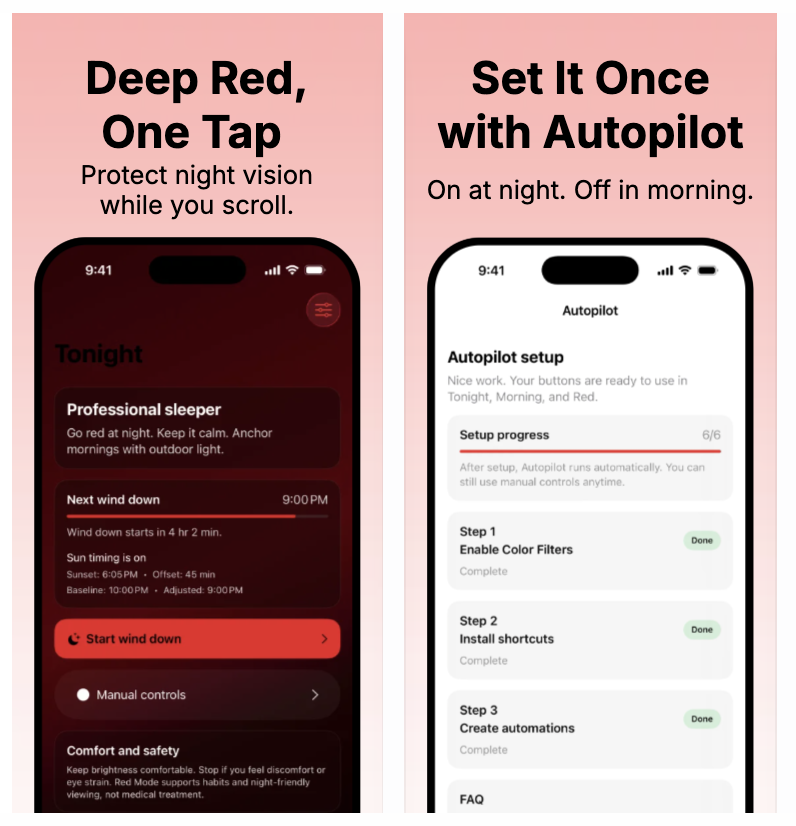
Deep Red, One Tap
If you scroll in bed, check your phone in a dark room, or just want a calmer screen at night, this is the main event.
Tap once and your screen goes deep red.
Set It Once with Autopilot
This is the feature I recommend for almost everyone.
Autopilot turns Red Mode on at night and off in the morning. It’s genuinely set-and-forget once you enable it.
Setup is intentionally fast. Installing the included Shortcuts and creating the automations takes about 2 minutes if you follow the steps.
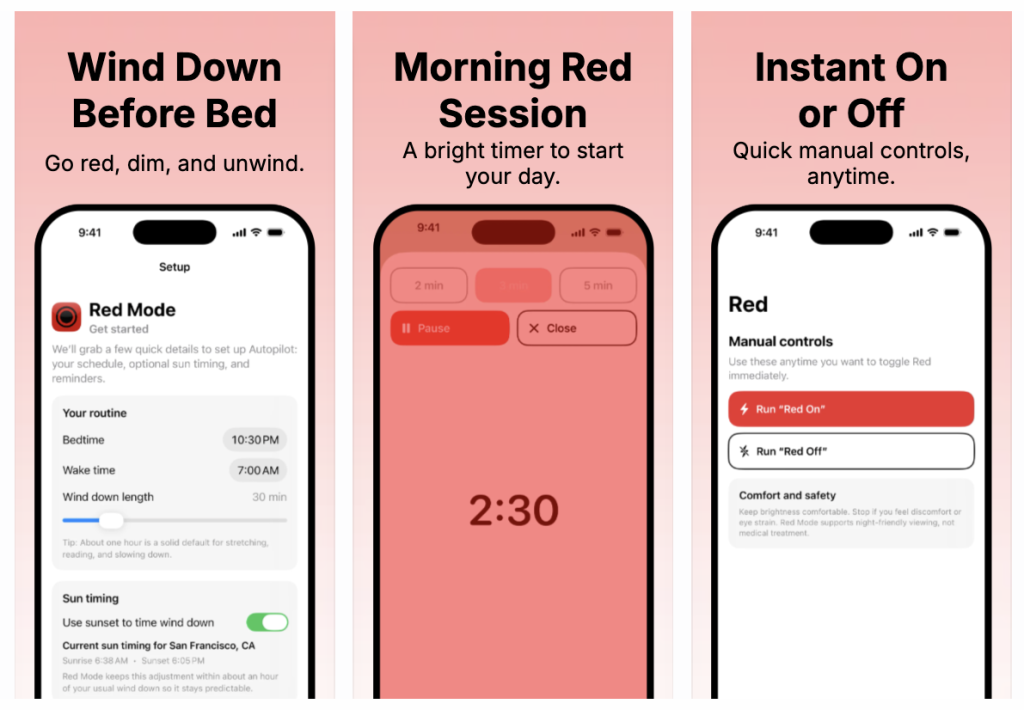
Wind Down Before Bed
Wind Down is for the nights you want an immediate reset.
Use it when:
- you did not set up Autopilot yet
- you are traveling or your schedule is different
- you want a quick, intentional “I’m done for the night” moment
If you do not set up Autopilot, Wind Down is what you will run each night.
If you do set up Autopilot, Wind Down becomes optional, like a manual override.
Morning Red Session
This one is different and very intentional.
Morning Red Session is a bright, timed red screen you can run in the morning. It’s built to support a simple routine with a timer, without overthinking it.
Instant On or Off
You can always toggle red on or off anytime. No ceremony, no digging.
Who It’s For
- bedtime scrollers who want a calmer screen at night
- parents checking a phone in a dark room
- night shift users
- stargazers and anyone protecting dark adaptation
- photographers and darkroom folks who want red light options
- anyone trying to build better sleep habits and a consistent evening routine
Design Notes
I thought a lot about keeping the design quiet and obvious. The app should feel like it belongs on your phone, not like a gadget.
It was a fun project to build, and I hope it’s genuinely useful for anyone who cares about sleep, routines, and longevity.
Price
Red Mode is a $0.99 one-time purchase. No subscription.
Download
You can grab it here:
https://apps.apple.com/us/app/red-mode-red-screen-night/id6759926783
If you try it, I’d love your feedback. And if you find it useful, a quick App Store review really helps.
🩺 Disclaimer
The content on I Won’t Die is for informational and educational purposes only. It is not a substitute for professional medical advice, diagnosis, or treatment. Always consult a qualified healthcare provider with any health concerns.
🚀 Get Started with Blueprint
Start optimizing your health today with $25 off your first order! Use our referral code to begin your Blueprint journey and take control of your longevity.
🏋️♂️ Track Your Sleep, Workouts & Recovery
Boost your performance and recovery with Whoop. Join with my referral link to get a free WHOOP 5.0 and one month free!
📲 Download the I Won’t Die App
Stay ahead with the latest news, updates, and insights. Download the I Won’t Die app now on the Apple App Store and Google Play!
📩 Contact Us
Have tips, photos, or questions? Want to collaborate? Reach out at [email protected] — we’d love to hear from you!
🔗 Stay Connected
Follow us on Don't Die, Facebook, X, Instagram, YouTube, and LinkedIn for Blueprint longevity and Bryan Johnson updates.
📬 Subscribe to I Won’t Die Newsletter
Get the latest longevity breakthroughs, Blueprint updates, and exclusive content straight to your inbox — sign up now!

Bryan Johnson shares his personal protocol for mastering sleep, backed by data, wearables, and years of experimentation.
Today, sleep isn’t just rest. It’s a skill you can master. Bryan Johnson calls it the greatest performance enhancing drug on Earth. Not a supplement or a superfood, but something you already do or should do every night.
In his latest video podcast episode, Bryan lays out the advanced sleep system he used to get eight consecutive months of perfect sleep. This isn’t a gimmick or another top 10 list. It’s a personal science experiment, honed by data and habit, that anyone can learn from.
Let’s break down what makes his protocol different and how you can apply it to your life.
Why Sleep Matters More Than You Think
Bryan makes it clear: sleep isn’t just a pillar of health, it’s the foundation. It influences your mood, your memory, your relationships, even your earning potential. And yet, most people treat sleep as optional, sacrificing it for work, social events, or binge watching stressful TV shows.
His point is simple: you wouldn’t show up late to a work meeting, so why show up late to your own bedtime?
Resting Heart Rate is Your Sleep Report Card
The secret weapon of Bryan’s sleep mastery is his resting heart rate before bed. Unlike typical wearables that track heart rate during sleep, Bryan focuses on what it’s doing right before his head hits the pillow.
If your heart rate is low at that moment, you’re primed for a great night. If it’s high, you’re headed for poor recovery. Food, stress, screens, arguments, anything that raises heart rate before bed is the enemy.
He uses this single metric to simplify the chaos of health and behavior. It’s the north star of his evening routine.
Food is the Number One Sleep Killer
According to Bryan and his team, nothing wrecks sleep like eating too close to bedtime, even if the food is “healthy.” Digestion activates the nervous system and raises heart rate. In Bryan’s case, even hummus and vegetables at the wrong time led to poor sleep data.
The takeaway: finish your final meal at least four hours before bed. For best results, aim for six to eight.
Become a Professional Sleeper
One of the most useful mindset shifts Bryan promotes is treating sleep like a job. Schedule it. Protect it. Track it. Improve it.
Here are his 10 essential tips for achieving elite sleep:
- Adopt a professional mindset – Sleep is your job.
- Stop eating early – Final meal 4 to 8 hours before bed.
- Start a wind down routine – 30 to 60 minutes of screen free calm.
- Use light to reset your clock – Get morning light or use a 10,000 lux lamp.
- Stick to a bedtime – Same time every night, ideally within a few minutes.
- Avoid caffeine late in the day – Its half life can destroy sleep quality.
- Eliminate blue light – Use red or amber lighting in the evening.
- Cool your room – 69 to 71°F is optimal.
- Control noise – Use sound machines or earplugs if needed.
- Track your data – Wearables help create powerful sleep habits.
Bonus Tips That Make a Big Difference
The team added a few more actionable strategies:
- Move your phone away from your bed to reduce the temptation to scroll.
- Try journaling before bed to unload mental clutter or anxiety.
- Use your bed only for sleep and sex to train your brain for rest.
- Sleep separately from your partner if necessary and if possible for higher quality rest.
These are the habits that support a long life, strong mind, and healthy body.
Final Thoughts
There’s no magic pill for better sleep. But there is a repeatable protocol, tested by Bryan and fine tuned with real data, that can help you get there. If you’re tired of feeling tired, his approach offers something powerful: control.
Track your heart rate. Experiment with your evening routine. Make one small change today. And most of all, treat sleep with the seriousness it deserves.
If you want to live longer, think sharper, and feel your best, it all starts with sleep. Got a sleep tip that works for you? Share it in the comments below.
🩺 Disclaimer
The content on I Won’t Die is for informational and educational purposes only. It is not a substitute for professional medical advice, diagnosis, or treatment. Always consult a qualified healthcare provider with any health concerns.
🚀 Get Started with Blueprint
Start optimizing your health today with $25 off your first order! Use our referral code to begin your Blueprint journey and take control of your longevity.
🏋️♂️ Track Your Sleep, Workouts & Recovery
Boost your performance and recovery with Whoop. Join with my referral link to get a free WHOOP 5.0 and one month free!
📲 Download the I Won’t Die App
Stay ahead with the latest news, updates, and insights. Download the I Won’t Die app now on the Apple App Store and Google Play!
📩 Contact Us
Have tips, photos, or questions? Want to collaborate? Reach out at [email protected] — we’d love to hear from you!
🔗 Stay Connected
Follow us on Don't Die, Facebook, X, Instagram, YouTube, and LinkedIn for Blueprint longevity and Bryan Johnson updates.
📬 Subscribe to I Won’t Die Newsletter
Get the latest longevity breakthroughs, Blueprint updates, and exclusive content straight to your inbox — sign up now!
This episode explores how daily 200°F sauna sessions led to major improvements in blood pressure, detoxification, and cellular health in just three weeks.
Today, we explore how 20 minutes a day in a 200°F dry sauna impacted Bryan Johnson’s body and biomarkers.
In Don’t Die Podcast #7, Bryan Johnson shares results from his latest self-experiment: a 21-day high-heat sauna protocol. While most people use a sauna to relax, Johnson’s team treated it like a clinical trial, tracking blood pressure, inflammation, mitochondrial health, and toxin excretion.
The results? Bryan and his team discuss measurable improvements in cardiovascular markers, potential reductions in toxin levels, and elevated heat shock proteins that play a role in cellular repair and longevity. The experience, however, was far from easy and required ice packs on his head and testicles to endure the heat.
Why sauna? The science behind the sweat
Research from Finland and other countries shows sauna use is associated with:
- 50 to 70 percent lower risk of cardiovascular disease
- 40 percent reduction in all-cause mortality
- Reduced dementia and Alzheimer’s risk
Most of these benefits are tied to heat stress, not just sweating. The body responds by increasing nitric oxide, dilating blood vessels, boosting circulation, and mimicking some of the effects of cardiovascular exercise. It also activates heat shock proteins, which repair damaged proteins and reduce inflammation.
Mimicking exercise without moving
Sauna exposure raises heart rate and mimics light aerobic activity like zone one cardio. It’s an “exercise mimetic,” producing cardiovascular effects without physical movement. Bryan saw:
- A 5.8 percent drop in central systolic blood pressure
- A 21 percent improvement in aortic flexibility
- A decrease in arterial stiffness based on augmentation index
These changes came after just 7 sessions and were maintained through 18 to 21 sessions, suggesting sauna is a fast-acting tool for vascular health.
The detox protocol and early biomarker shifts
Bryan and his team tracked 100+ biomarkers including inflammation (CRP), growth hormone, cortisol, vascular age, and mitochondrial function. Highlights included:
- CRP dropped approximately 30 percent
- Blood flow visibly improved during blood draws
- Bryan’s vascular age decreased from 29 to early 20s
Although not all markers changed (his baseline was already elite), the sauna appeared to boost the body’s ability to detox. They expect to see drops in heavy metals, phthalates, and persistent organic pollutants in upcoming urine toxin panels.
Icing testicles, sleepless nights, and cramping
This wasn’t a spa day. For the first two weeks, Bryan felt exhausted, had disrupted sleep, and suffered intense cramps due to electrolyte loss. To mitigate the effects:
- He used ice packs on his head and genitals
- He added 600–700 mg sodium, plus potassium and magnesium, post-sauna
- He wore cotton clothing to avoid plastic toxins
- He shifted his sauna timing away from bedtime to improve sleep
He also avoided pouring water on sauna rocks, due to concerns over toxins in tap water becoming airborne in steam.
Dry vs. wet sauna and how to replicate the protocol at home
Bryan’s team chose a dry Finnish-style sauna at 200°F with 10–20 percent humidity. This style has the strongest research backing. Wet or infrared saunas can still provide benefit, but often don’t reach therapeutic heat levels.
His at-home protocol is:
- 20 minutes at 200°F
- Every day or nearly every day
- Ice packs on sensitive areas
- Electrolyte hydration before and after
- Immediate shower after to wash off toxins
Anyone can start this protocol with modifications. The key is to ease in slowly. Start with 140°F, limit sessions to 2 to 3 per week, and gradually build up.
Who should avoid sauna use?
Bryan’s team flagged several populations who should proceed with caution:
- Pregnant individuals
- People with unmanaged cardiovascular conditions
- Those with electrolyte disorders or dizziness-prone conditions like POTS
Always consult a physician before starting an intense heat therapy protocol.
Sauna and the broader longevity mission
Bryan frames his sauna protocol as more than health optimization. It is part of a broader movement to reduce death in all its forms and extend human potential. The Don’t Die mission is to reject default aging and experiment with new systems of living that improve vitality, brain function, and emotional wellbeing.
Final Thoughts
Bryan Johnson’s sauna protocol isn’t for the faint of heart, but the early results are compelling. From a drop in blood pressure to signs of toxin elimination and increased heat shock protein activity, 20-minute dry sauna sessions may offer one of the simplest, most accessible longevity interventions available today. Whether you’re optimizing for cardiovascular health, brain performance, or detoxification, sauna might be your next great protocol.
🩺 Disclaimer
The content on I Won’t Die is for informational and educational purposes only. It is not a substitute for professional medical advice, diagnosis, or treatment. Always consult a qualified healthcare provider with any health concerns.
🚀 Get Started with Blueprint
Start optimizing your health today with $25 off your first order! Use our referral code to begin your Blueprint journey and take control of your longevity.
🏋️♂️ Track Your Sleep, Workouts & Recovery
Boost your performance and recovery with Whoop. Join with my referral link to get a free WHOOP 5.0 and one month free!
📲 Download the I Won’t Die App
Stay ahead with the latest news, updates, and insights. Download the I Won’t Die app now on the Apple App Store and Google Play!
📩 Contact Us
Have tips, photos, or questions? Want to collaborate? Reach out at [email protected] — we’d love to hear from you!
🔗 Stay Connected
Follow us on Don't Die, Facebook, X, Instagram, YouTube, and LinkedIn for Blueprint longevity and Bryan Johnson updates.
📬 Subscribe to I Won’t Die Newsletter
Get the latest longevity breakthroughs, Blueprint updates, and exclusive content straight to your inbox — sign up now!

The Foods That Help Me Eat Big and Stay 155 to 160 lbs

I’m Officially a Rejuvenation Olympian, Ranked #167 Behind Bryan Johnson

When More Exercise Stops Moving the Needle

I Took My Function Health Mid-Year Test: Now We Wait

Download the New I Won’t Die App: Longevity News, Biohacking Insights, and Health Tools

The Best Advice Bryan Johnson Has Ever Given

Stop Guessing Your Run: StayGreen Turns WHOOP Data Into Today’s Training Decision

Electrolytes: The Small Habit That Quietly Changed My Recovery

Mission Accomplished: My Speed of Aging Result Is In and Blueprint Confirms the Trend

Take Two: The Speed of Aging Redemption

Red Mode Is Live: Become a Professional Sleeper

Function Health January Labs: One Year Later

Blood, Biomarkers, and Beach Miles

Starting the Year Strong, Not From Scratch

How To Build Great Health One Boring Day at a Time

Bryan Johnson Shares Details of His HBOT Protocol for Longevity

Bryan Johnson Updates His Morning Routine Again: Here’s What’s New in May 2025

The Healthiest Lab Results Ever Recorded? Inside Bryan Johnson’s Longevity Bloodwork

Bryan Johnson Sat in a 200°F Sauna for 7 Days. Here’s What Changed

How Sauna Sessions Helped Bryan Johnson Eliminate 7 Harmful Toxins

How Strong Are Your Bones? Bryan Johnson’s Blueprint for Bone Health and Longevity

WHOOP MG Review: Improved Accuracy, New Features, and How WHOOP Age Compares to Blueprint’s Speed of Aging

Bryan Johnson’s 2025 Skincare Routine Revealed: How He Reversed His Skin Age by Decades

How Bryan Johnson Removed 93 Percent of Microplastics From His Blood

Inside Bryan Johnson’s 2025 Longevity Protocol and Why It Inspires Me

Don’t Die Podcast #3: Why Resting Heart Rate May Be the Most Powerful Health Metric for Sleep and Longevity

My Blueprint Advanced Panel Results: A Deep Dive into Longevity Biomarkers

The One Food Bryan Johnson Swears By for Longevity: Extra Virgin Olive Oil

How Bryan Johnson Gets Perfect Sleep Scores Every Night: A Blueprint for Deep Rest

Who Is the Healthiest Person in the World? This Man’s Data-Driven Life May Be the Answer
-

 Bryan Johnson Updates9 months ago
Bryan Johnson Has A Girlfriend: Finding The Person Who Feels Like Home And Why It Changes Everything
-
 My Longevity Journey10 months ago
WHOOP Advanced Labs: Understanding the Body Behind the Data
-

 Bryan Johnson Updates10 months ago
Sauna, Fertility, and Why This Matters More Than Ever
-
 My Longevity Journey11 months ago
How I Cut My ApoB by 51% Without Medication