Miscellaneous News
Saliva vs Blood Tests for Biological Age: Which One Actually Works?

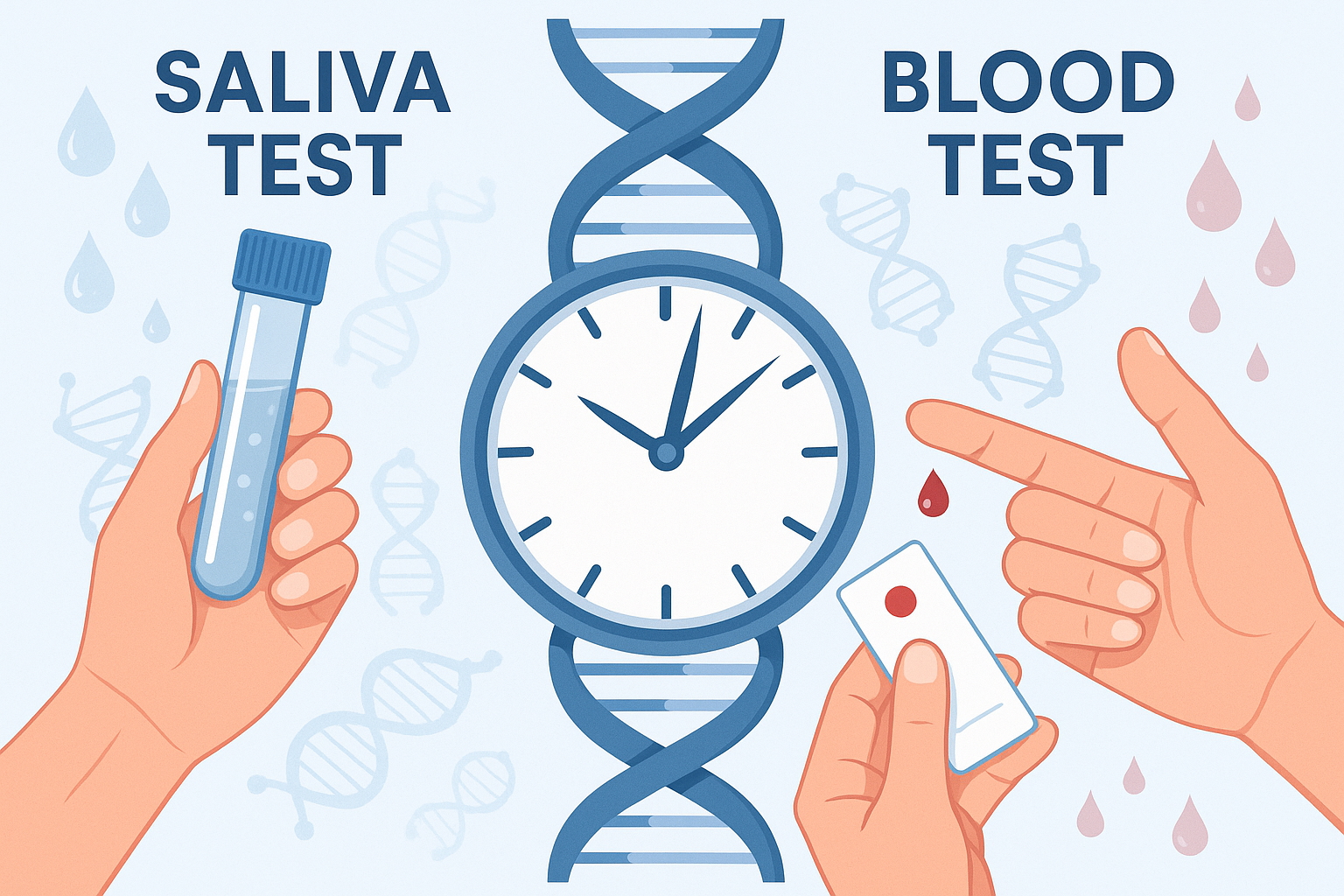
A new saliva-based epigenetic clock offers a fast, affordable way to estimate biological age, but how does it compare to blood-based aging tests like Blueprint?
Today, a new study introduced a 10-CpG saliva test that claims it can estimate your biological age with just a spit sample. Researchers analyzed DNA methylation patterns from over 3,400 people and found that just ten specific sites in your saliva can predict your age with surprising accuracy. It’s cheap, non-invasive, and fast. However, how does this compare to blood-based tests like Blueprint’s Speed of Aging test, which we’ve already used and plan to use again later this year?
Let’s break it down.
What the 10-CpG Saliva Clock Measures
This new study, published in DNA in June 2025, describes a minimalist epigenetic clock built from just 10 CpG sites in saliva DNA. These are regions in your genome where methylation, a chemical modification that changes with age, can be measured.
The researchers found that this small set of sites could predict a person’s chronological age with a correlation of 0.80 and a mean error of around 5.5 years. In other words, if you’re 45, the test might guess you’re anywhere from 40 to 50.
It’s based on data from healthy individuals aged 15 to 89 and uses the Illumina EPIC 850k array to detect age-related hypermethylation patterns in genes related to metabolism, cognitive function, and hormone signaling.
How It Compares to Blueprint’s Speed of Aging Test
We’ve done the Speed of Aging test through Blueprint. It required a simple finger prick and a few drops of blood on a sample card. That blood was then used to calculate our biological rate of aging, not just our age.
Unlike the saliva test, which estimates how old you are, Blueprint’s blood-based test (built on the DunedinPACE algorithm) tells you how fast you’re aging at a cellular level. A score of 1.00 means you’re aging biologically one year per calendar year. A score below 1.00 means you’re slowing the clock.
These blood-based tests use over 100 CpG markers and are trained on decades of longitudinal health data, giving them more depth and better predictive power for things like disease risk, cognitive decline, and overall healthspan.
When to Use a Saliva Test
The saliva clock is compelling, because it’s easy and low-cost. It doesn’t require a blood draw or even a finger prick. That makes it a great entry point for tracking biological age, especially for those who are curious but not ready to invest in more advanced diagnostics.
It could also be a useful tool for broad population screening or longitudinal tracking when cost and convenience are priorities.
However, it’s important to note what it is not. It does not measure your pace of aging. It cannot tell you if your lifestyle changes are working. And while it highlights some genes that are biologically meaningful, it lacks the depth and validation that DunedinPACE and Blueprint offer.
Use Case Comparison
| Scenario | 10-CpG Saliva Clock | DunedinPACE / Blueprint Speed of Aging |
|---|---|---|
| Quick, non-invasive test | ✅ Yes | ❌ Requires blood |
| Low-cost or consumer health tracking | ✅ Ideal | ❌ More expensive, lab dependent |
| Longitudinal rate of aging tracking | ❌ Not designed for this | ✅ Gold standard for tracking pace of aging |
| Used in research predicting mortality/disease | ❌ Not yet | ✅ Extensively validated |
| Useful for lifestyle intervention testing | ⚠️ Limited sensitivity | ✅ Highly responsive to lifestyle changes |
| Blueprint’s internal model | ❌ No (Blueprint uses DunedinPACE) | ✅ Yes – Blueprint’s “Speed of Aging” is based on DunedinPACE |
Our Take on the Science
After researching the two, here’s where things get interesting. The ten CpG sites in this saliva test are associated with genes like ELOVL2 (linked to fat metabolism and eye health), CHGA (tied to blood pressure), and GPR158 (involved in mood and cognition). That gives this clock biological credibility.
But the test is limited to measuring DNA from saliva, which includes a mix of epithelial and immune cells, not the full systemic picture that blood can provide.
Blood tests like Blueprint are better suited for identifying whether you are aging faster or slower than average, and they have been linked to real-world outcomes like cardiovascular disease, dementia risk, and mortality.
Accuracy and Scientific Depth
| Feature | 10-CpG Saliva Clock | DunedinPACE / Speed of Aging (Blood) |
|---|---|---|
| Input | Saliva DNA (non-invasive) | Blood DNA (invasive) |
| Markers Used | 10 CpG sites | ~173 CpG sites |
| Primary Output | Predicted biological age | Biological aging rate (relative to normal pace) |
| Correlation to Chronological Age | r = 0.80 (good) | Not designed to predict age, but pace (biological drift) |
| Mean Absolute Error | ~5.5 years | N/A – not estimating age, but speed |
| Scientific Foundation | Cross-sectional saliva DNA data | Longitudinal 20-year Dunedin cohort + functional healthspan outcomes |
| Predictive Power for Health Outcomes | Moderate (saliva age proxy) | High – associated with morbidity, mortality, cognitive decline, fitness decline, etc. |
Final Thoughts
The new saliva-based epigenetic clock is an exciting development. It opens the door to wider access and mainstream curiosity around biological aging. If all you want is a rough estimate of your biological age without pricking your finger, it’s a good starting point.
But if you’re serious about understanding the trajectory of your health and longevity, and whether your lifestyle changes are working, blood-based models like Blueprint’s Speed of Aging test remain the gold standard.
We’ll be doing another blood-based test later this year to see if our lifestyle upgrades are slowing the clock. Until then, we’re keeping an eye on how these simpler models evolve and what they might tell us about the biology of aging, one molecule at a time.
🩺 Disclaimer
The content on I Won’t Die is for informational and educational purposes only. It is not a substitute for professional medical advice, diagnosis, or treatment. Always consult a qualified healthcare provider with any health concerns.
🚀 Get Started with Blueprint
Start optimizing your health today with $25 off your first order! Use our referral code to begin your Blueprint journey and take control of your longevity.
🏋️♂️ Track Your Sleep, Workouts & Recovery
Boost your performance and recovery with Whoop. Join with my referral link to get a free WHOOP 5.0 and one month free!
📲 Download the I Won’t Die App
Stay ahead with the latest news, updates, and insights. Download the I Won’t Die app now on the Apple App Store and Google Play!
📩 Contact Us
Have tips, photos, or questions? Want to collaborate? Reach out at [email protected] — we’d love to hear from you!
🔗 Stay Connected
Follow us on Don't Die, Facebook, X, Instagram, YouTube, and LinkedIn for Blueprint longevity and Bryan Johnson updates.
📬 Subscribe to I Won’t Die Newsletter
Get the latest longevity breakthroughs, Blueprint updates, and exclusive content straight to your inbox — sign up now!



Miscellaneous News
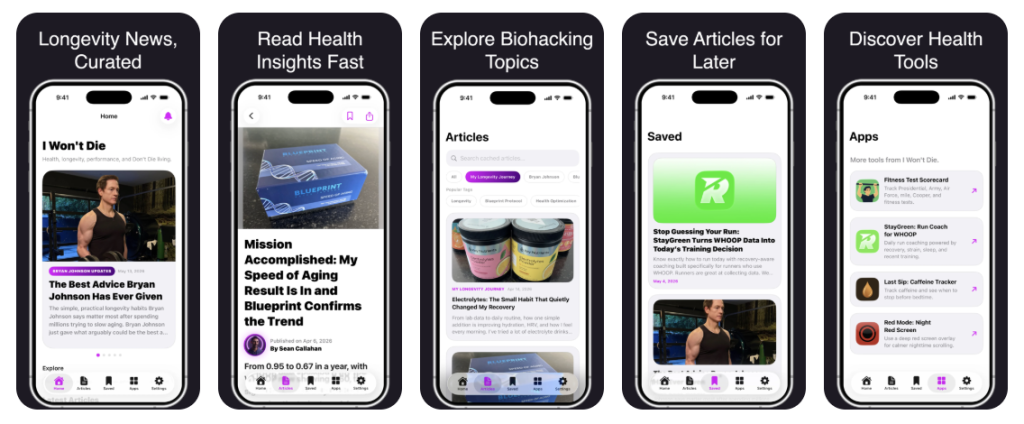
Download the New I Won’t Die App: Longevity News, Biohacking Insights, and Health Tools

A faster, rebuilt iPhone app for curated longevity news, Bryan Johnson and Blueprint commentary, biomarker insights, fitness, recovery, nutrition, and practical health optimization.
The new I Won’t Die iOS app is now available.
It has been rebuilt as a faster, fully native iPhone experience. The app helps you follow longevity news, biohacking insights, and practical health optimization.
Inside, you can read curated articles on healthspan, biomarkers, fitness, recovery, sleep, nutrition, and performance. Coverage also includes Bryan Johnson, Blueprint, the Blueprint protocol, and the Don’t Die movement.
This update brings a cleaner Home screen with featured articles, latest posts, topics, and health tools. Articles now open in a polished native reading view. You can save posts, share articles, explore related content, and open links more easily.
Image handling, article formatting, and overall performance have also been improved. You can also turn on push notifications for newly published articles.
The goal is simple: stay informed without the clutter. No noisy popups. No distractions. Just curated longevity and health content in a clean app built for light mode and dark mode.
Whether you follow Bryan Johnson and Blueprint, or simply care about better health, the app keeps things focused. It is built for curious readers, biohackers, fitness-minded people, and anyone working toward a healthier life.
Download the new iOS app here:
https://apps.apple.com/us/app/i-wont-die/id6745723273
The Android version is also available, with the new update coming later:
https://play.google.com/store/apps/details?id=appiwontdiecom.wpapp
🩺 Disclaimer
The content on I Won’t Die is for informational and educational purposes only. It is not a substitute for professional medical advice, diagnosis, or treatment. Always consult a qualified healthcare provider with any health concerns.
🚀 Get Started with Blueprint
Start optimizing your health today with $25 off your first order! Use our referral code to begin your Blueprint journey and take control of your longevity.
🏋️♂️ Track Your Sleep, Workouts & Recovery
Boost your performance and recovery with Whoop. Join with my referral link to get a free WHOOP 5.0 and one month free!
📲 Download the I Won’t Die App
Stay ahead with the latest news, updates, and insights. Download the I Won’t Die app now on the Apple App Store and Google Play!
📩 Contact Us
Have tips, photos, or questions? Want to collaborate? Reach out at [email protected] — we’d love to hear from you!
🔗 Stay Connected
Follow us on Don't Die, Facebook, X, Instagram, YouTube, and LinkedIn for Blueprint longevity and Bryan Johnson updates.
📬 Subscribe to I Won’t Die Newsletter
Get the latest longevity breakthroughs, Blueprint updates, and exclusive content straight to your inbox — sign up now!
Miscellaneous News
Stop Guessing Your Run: StayGreen Turns WHOOP Data Into Today’s Training Decision

Know exactly how to run today with recovery-aware coaching built specifically for runners who use WHOOP.
Runners are great at collecting data.
We have watches, heart-rate zones, recovery scores, sleep scores, strain targets, pace charts, weekly mileage, training plans, and enough graphs to make a NASA engineer feel seen. 🚀
I do it daily using multiple apps and with my WHOOP device.
But there is one question most runners still ask almost every day, including myself:
What should I actually do today?
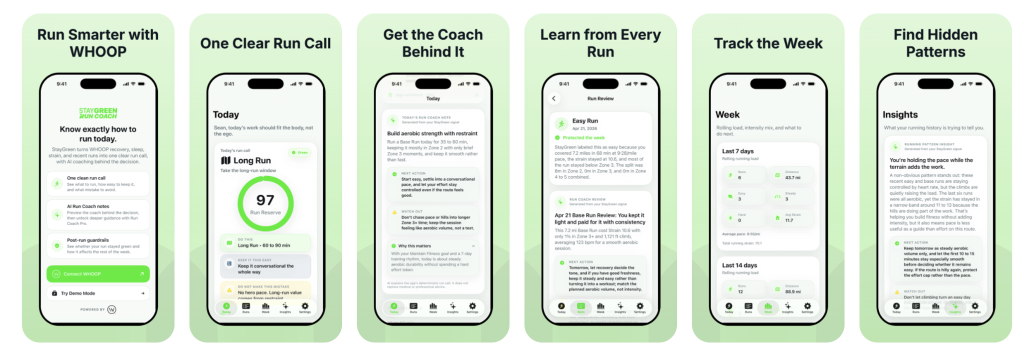
That is exactly why I built StayGreen: Run Coach for WHOOP, a new iOS app designed specifically for runners who use WHOOP and want clearer, smarter, more actionable run guidance.
StayGreen takes your WHOOP recovery, sleep, strain, HRV, resting heart rate, physiological cycle data, and recent running history, then turns all of that signal into one focused daily run call.
Not a dashboard full of numbers, a vague “listen to your body,” or a general strain target.
A real running decision.
Should you run easy? Keep it aerobic? Move the long run? Take a recovery walk? Protect the week? Use today as a controlled quality window?
StayGreen is built to help you know in about five seconds.
Why StayGreen Exists
WHOOP gives runners powerful data. Recovery, strain, sleep, HRV, resting heart rate, workouts, and physiological trends can all tell you something important.
But runners do not just need more metrics.
They need translation.
Because a green recovery does not always mean “go crush yourself.” A yellow day does not always mean “do nothing.” A red day might not mean the week is ruined. And sometimes the smartest training move is not the hardest one, but the one that keeps tomorrow alive.
StayGreen sits on top of your WHOOP data and adds a running-specific coaching layer.
It looks at your baseline, your recent runs, your weekly load, your hard-effort spacing, your long-run timing, and the cost of your recent training. Then it answers the practical question runners care about most:
How should I run today?
The Daily Run Call
At the center of StayGreen is the Daily Run Call.
This is your simple, readable recommendation for the day. It brings together recovery, sleep, strain, HRV-informed readiness, recent running load, and your current running goal.
You might see guidance like:
- Run easy.
- Keep it aerobic.
- Move the long run.
- Take a recovery walk.
- Protect the week.
- Use today as a controlled quality window.
The goal is not to make every green day bigger. The goal is to train with better timing, better restraint, and better awareness of how today affects tomorrow.
That is the idea behind the name StayGreen. It is not about chasing green harder or turning every good recovery day into a test. It is about staying consistent, durable, and ready for the next run.
For me personally, that means longevity running: a daily seven-mile rhythm where the goal is not to empty the tank, but to finish feeling strong, recover well, and wake up ready to do it again.
Meet Run Reserve
StayGreen also introduces a simple score called Run Reserve.
Run Reserve helps answer: “How much running capacity do I have today?”
It is not just a recovery score. It is a running-readiness signal that considers your WHOOP data alongside recent training load, sleep, strain, and baseline trends.
A high Run Reserve might mean you have room to extend, build, or execute the plan.
A lower Run Reserve might mean the better move is to keep things easy, shorten the run, or protect the rest of the week.
It gives runners a practical way to understand capacity without needing to interpret every underlying metric manually.
The Coach Behind the Decision
StayGreen is free to download and includes core daily guidance, but runners who upgrade to Run Coach Pro unlock the AI coaching layer behind the decisions.
That is where the app gets even more useful.
Run Coach Pro adds AI-assisted coach notes that explain what to do, why it matters, and the mistake to avoid. Instead of only seeing the recommendation, you get the reasoning behind it.
For example, StayGreen might tell you that today is better suited for aerobic work because your weekly load is already climbing, your last hard effort is still recent, and your recovery is good enough to move but not ideal for forcing intensity.
That kind of context helps you train smarter, not just obey a score.
Post-Run Coaching That Actually Teaches You Something
A lot of running apps are built around what happened.
StayGreen is built around what it means.
After a run, StayGreen looks at the effort and helps you understand whether you protected the week, spent too much, or kept the run right where it needed to be.
It can identify when an easy run quietly turned into a workout, show when a run was controlled enough to support tomorrow, and help you understand what today’s effort may have cost your body and how it affects your next decision.
That is especially helpful for runners who love to push, because the line between “easy” and “accidentally spicy” can get blurry fast.
Weekly Coaching and Hidden Patterns
StayGreen is not only about today.
The app also helps you understand your week.
With Run Coach Pro, you can unlock weekly coach reads and running pattern insights that look at rolling load, intensity mix, long-run readiness, normal range, and trends that are easy to miss.
Maybe your base runs are getting smoother, while your easy days are quietly drifting too hard. Maybe your weekly load is climbing faster than your recovery can support, or the terrain, heat, hills, and pacing patterns are making certain runs more expensive than expected.
StayGreen helps surface those patterns so you can make better choices before your body has to send the message louder.
Built Around Your Goal
StayGreen adapts its recommendations based on what kind of runner you are trying to be right now.
You can use it for:
- Build Base
- Improve Speed
- 5K and 10K training
- Half Marathon training
- Marathon training
- Longevity Running
- Return to Running
- Maintain Fitness
Whether you are coming back carefully, building durability, chasing a race goal, or simply trying to run consistently without burning out, StayGreen helps interpret your WHOOP data through the lens of your actual running goal.
Free vs. Run Coach Pro
StayGreen is free to download.
The free version includes your daily WHOOP-powered run call, Run Reserve score, basic post-run recap, basic weekly load, and limited coach note previews.
Run Coach Pro unlocks the deeper coaching layer, including AI Run Coach Notes, Post-Run Coach Notes, Weekly Coach Reads, Running Pattern Insights, full history, long-run guidance, Training Cost, and regenerated coach notes.
So you can start with the simple daily decision, then upgrade when you want the coach behind the call.
Who StayGreen Is For
StayGreen is for runners who use WHOOP and want their recovery data to become more actionable.
Use it when you wake up wondering whether today should be easy or hard.
Bring it into your training when you are preparing for a 5K, 10K, half marathon, or marathon and want to avoid blindly stacking fatigue.
Rely on it when consistency matters more than hero workouts.
Open it when you love data, but really want decisions.
Most of all, StayGreen is for runners who want to train better with restraint, because the best run is not always the hardest run.
Sometimes the best run is the one that keeps the week alive.
Download StayGreen for iOS
StayGreen: Run Coach for WHOOP is available now for iPhone.
Download it here:
https://apps.apple.com/us/app/staygreen-run-coach-for-whoop/id6762893528
StayGreen is independent and not affiliated with, endorsed by, or sponsored by WHOOP.
🩺 Disclaimer
The content on I Won’t Die is for informational and educational purposes only. It is not a substitute for professional medical advice, diagnosis, or treatment. Always consult a qualified healthcare provider with any health concerns.
🚀 Get Started with Blueprint
Start optimizing your health today with $25 off your first order! Use our referral code to begin your Blueprint journey and take control of your longevity.
🏋️♂️ Track Your Sleep, Workouts & Recovery
Boost your performance and recovery with Whoop. Join with my referral link to get a free WHOOP 5.0 and one month free!
📲 Download the I Won’t Die App
Stay ahead with the latest news, updates, and insights. Download the I Won’t Die app now on the Apple App Store and Google Play!
📩 Contact Us
Have tips, photos, or questions? Want to collaborate? Reach out at [email protected] — we’d love to hear from you!
🔗 Stay Connected
Follow us on Don't Die, Facebook, X, Instagram, YouTube, and LinkedIn for Blueprint longevity and Bryan Johnson updates.
📬 Subscribe to I Won’t Die Newsletter
Get the latest longevity breakthroughs, Blueprint updates, and exclusive content straight to your inbox — sign up now!

America’s favorite celebration comes with a hidden cost and that is air pollution, brain damage, and toxic exposure that rivals chain smoking.
Today, we recover from celebrating America’s birthday with fireworks and from inhaling the consequences. Yes, we’re talking about air quality outdoors post celebration.
Every year on July 4th, skies across the United States explode with color. It’s a tradition rooted in pride, patriotism, and the pursuit of happiness. However, while we celebrate our freedom, our bodies quietly absorb the cost.
Bryan Johnson recently shared what that cost looks like. According to his air quality monitors, PM₂.₅ levels during fireworks reached 160 micrograms per cubic meter, the equivalent of smoking a full cigarette in just one evening. In some areas, the air was as toxic as smoking 20 cigarettes. That’s not just patriotic, it’s poisonous.
Fireworks and Fine Particulates
Fireworks release a cocktail of harmful pollutants, including particulate matter (PM₂.₅), heavy metals like strontium and barium, and ultrafine soot. PM₂.₅ is especially concerning because it’s small enough to enter your lungs, bloodstream, and even cross the blood–brain barrier, potentially impacting brain health.
According to the EPA and NIH, exposure to PM₂.₅ has been linked to:
- Increased risk of cardiovascular disease
- Declines in cognitive function
- Higher rates of depression and anxiety
- Disruption of immune and cancer surveillance systems
In other words, these celebrations aren’t just loud, they’re neurotoxic.
It Doesn’t Stop in the Sky
What goes up must come down. Firework residue settles into our soil and water, where it contaminates food sources and drinking water. These heavy metals and chemicals don’t vanish after the show. They linger, bioaccumulate, and eventually make their way into our bodies again through food and water.
Fireworks are also a major cause of wildlife stress, asthma flare-ups, and ER visits during holiday weekends. The environmental and public health burden is significant, but we Americans love our fireworks to celebrate our country’s birthday.
Your Home Is a Sanctuary, If You Treat It Like One
Bryan’s data also shows that air quality inside his home remained dramatically better than outside during the fireworks, thanks to airtight building design, air purifiers, and filtered HVAC systems. In contrast, most homes without filtration offer little protection. Outdoor toxins easily infiltrate through vents, windows, and poorly sealed walls.
You can reduce your exposure with:
- HEPA or carbon-based air purifiers
- Keeping windows closed on high-pollution days
- Monitoring air quality with tools like PurpleAir or IQAir
- Using filtered masks if outdoors during high PM events
Alcohol and the Holiday Hangover
Bryan also called out another July 4th staple: alcohol. While drinking might seem like part of the fun, it comes with its own list of problems:
- It impairs neurogenesis and cognitive function
- Weakens immune response and cancer surveillance
- Disrupts sleep cycles
- Increases risk of depression and brain inflammation
So while it may feel like “letting loose,” you’re actually doing more long-term damage than you might think. Plain and simple. Don’t drink alcohol.
Final Thoughts
Our traditions mean something. They connect us to history, to each other, and to a shared sense of identity. However, if we’re honest, some of these customs are outdated and damaging, especially when we have the data to prove it.
This isn’t about canceling fireworks or outlawing alcohol. It’s about being informed. If we can send rockets into the sky to dazzle the nation, we can also find ways to celebrate without poisoning the air, water, and ourselves. Maybe it’s time to embrace drone-only firework displays on the 4th of July!
Let’s find ways to celebrate freedom that don’t come at the cost of our health. The future deserves clean air, conscious choices, and the kind of optimism that builds smarter traditions. Can patriotism shine just as brightly without the explosions? Share your thoughts in the comments below. 🎆
🩺 Disclaimer
The content on I Won’t Die is for informational and educational purposes only. It is not a substitute for professional medical advice, diagnosis, or treatment. Always consult a qualified healthcare provider with any health concerns.
🚀 Get Started with Blueprint
Start optimizing your health today with $25 off your first order! Use our referral code to begin your Blueprint journey and take control of your longevity.
🏋️♂️ Track Your Sleep, Workouts & Recovery
Boost your performance and recovery with Whoop. Join with my referral link to get a free WHOOP 5.0 and one month free!
📲 Download the I Won’t Die App
Stay ahead with the latest news, updates, and insights. Download the I Won’t Die app now on the Apple App Store and Google Play!
📩 Contact Us
Have tips, photos, or questions? Want to collaborate? Reach out at [email protected] — we’d love to hear from you!
🔗 Stay Connected
Follow us on Don't Die, Facebook, X, Instagram, YouTube, and LinkedIn for Blueprint longevity and Bryan Johnson updates.
📬 Subscribe to I Won’t Die Newsletter
Get the latest longevity breakthroughs, Blueprint updates, and exclusive content straight to your inbox — sign up now!

The Foods That Help Me Eat Big and Stay 155 to 160 lbs

I’m Officially a Rejuvenation Olympian, Ranked #167 Behind Bryan Johnson

When More Exercise Stops Moving the Needle

I Took My Function Health Mid-Year Test: Now We Wait

Download the New I Won’t Die App: Longevity News, Biohacking Insights, and Health Tools

The Best Advice Bryan Johnson Has Ever Given

Stop Guessing Your Run: StayGreen Turns WHOOP Data Into Today’s Training Decision

Electrolytes: The Small Habit That Quietly Changed My Recovery

Mission Accomplished: My Speed of Aging Result Is In and Blueprint Confirms the Trend

Take Two: The Speed of Aging Redemption

Red Mode Is Live: Become a Professional Sleeper

Function Health January Labs: One Year Later

Blood, Biomarkers, and Beach Miles

Starting the Year Strong, Not From Scratch

How To Build Great Health One Boring Day at a Time

Bryan Johnson Shares Details of His HBOT Protocol for Longevity

Bryan Johnson Updates His Morning Routine Again: Here’s What’s New in May 2025

The Healthiest Lab Results Ever Recorded? Inside Bryan Johnson’s Longevity Bloodwork

Bryan Johnson Sat in a 200°F Sauna for 7 Days. Here’s What Changed

How Sauna Sessions Helped Bryan Johnson Eliminate 7 Harmful Toxins

How Strong Are Your Bones? Bryan Johnson’s Blueprint for Bone Health and Longevity

WHOOP MG Review: Improved Accuracy, New Features, and How WHOOP Age Compares to Blueprint’s Speed of Aging

Bryan Johnson’s 2025 Skincare Routine Revealed: How He Reversed His Skin Age by Decades

How Bryan Johnson Removed 93 Percent of Microplastics From His Blood

Inside Bryan Johnson’s 2025 Longevity Protocol and Why It Inspires Me

Don’t Die Podcast #3: Why Resting Heart Rate May Be the Most Powerful Health Metric for Sleep and Longevity

My Blueprint Advanced Panel Results: A Deep Dive into Longevity Biomarkers

The One Food Bryan Johnson Swears By for Longevity: Extra Virgin Olive Oil

How Bryan Johnson Gets Perfect Sleep Scores Every Night: A Blueprint for Deep Rest

Who Is the Healthiest Person in the World? This Man’s Data-Driven Life May Be the Answer
-

 Bryan Johnson Updates10 months ago
Bryan Johnson Has A Girlfriend: Finding The Person Who Feels Like Home And Why It Changes Everything
-
 My Longevity Journey10 months ago
WHOOP Advanced Labs: Understanding the Body Behind the Data
-

 Bryan Johnson Updates10 months ago
Sauna, Fertility, and Why This Matters More Than Ever
-

 My Longevity Journey11 months ago
How I Cut My ApoB by 51% Without Medication