Miscellaneous News
What Ted Ryce Would Tell His 20-Year-Old Self About Health, Confidence, and Longevity

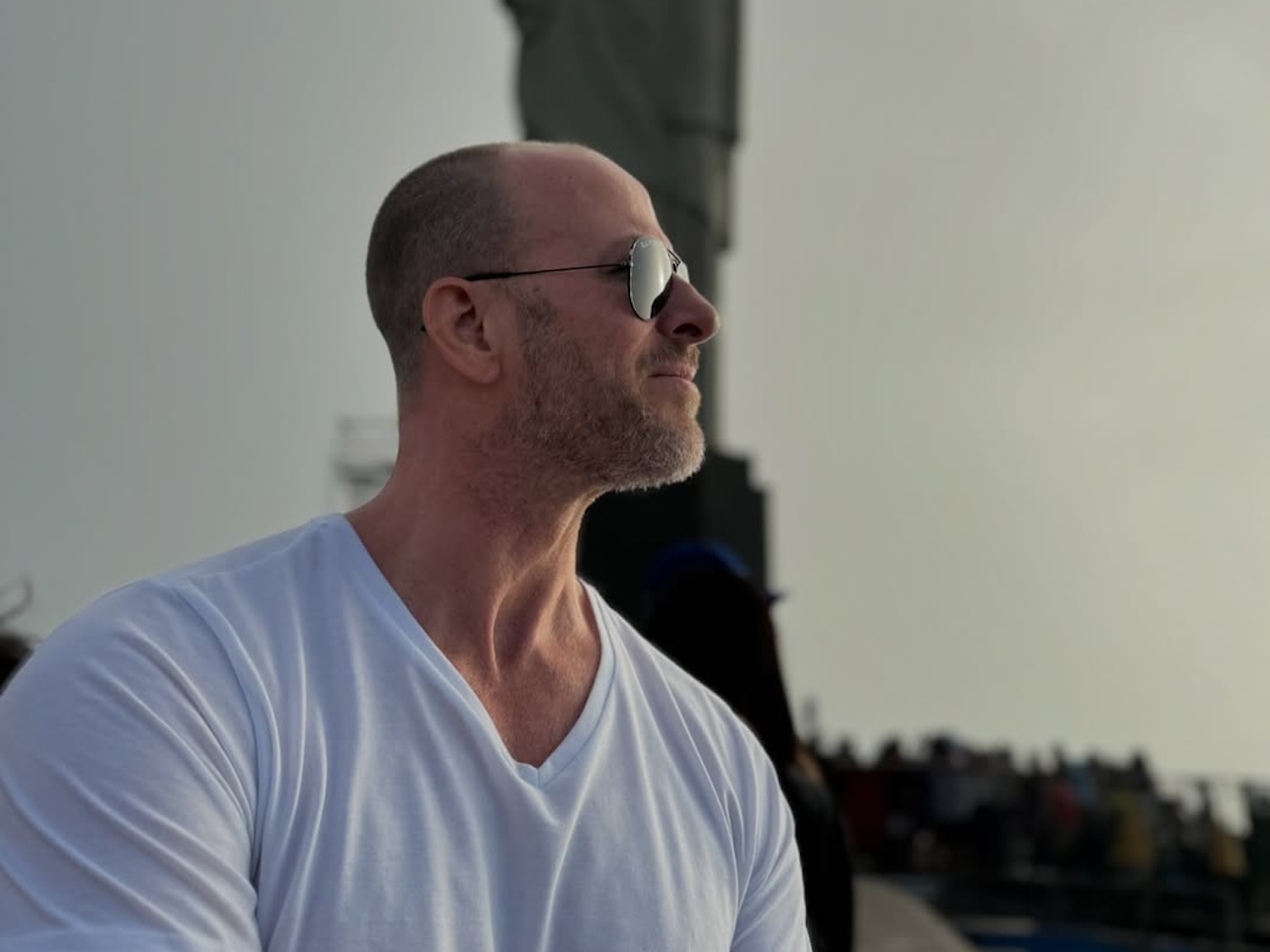
Health coach Ted Ryce shares 18 life-changing lessons for younger men that align with the Don’t Die mission of maximizing healthspan and vitality.
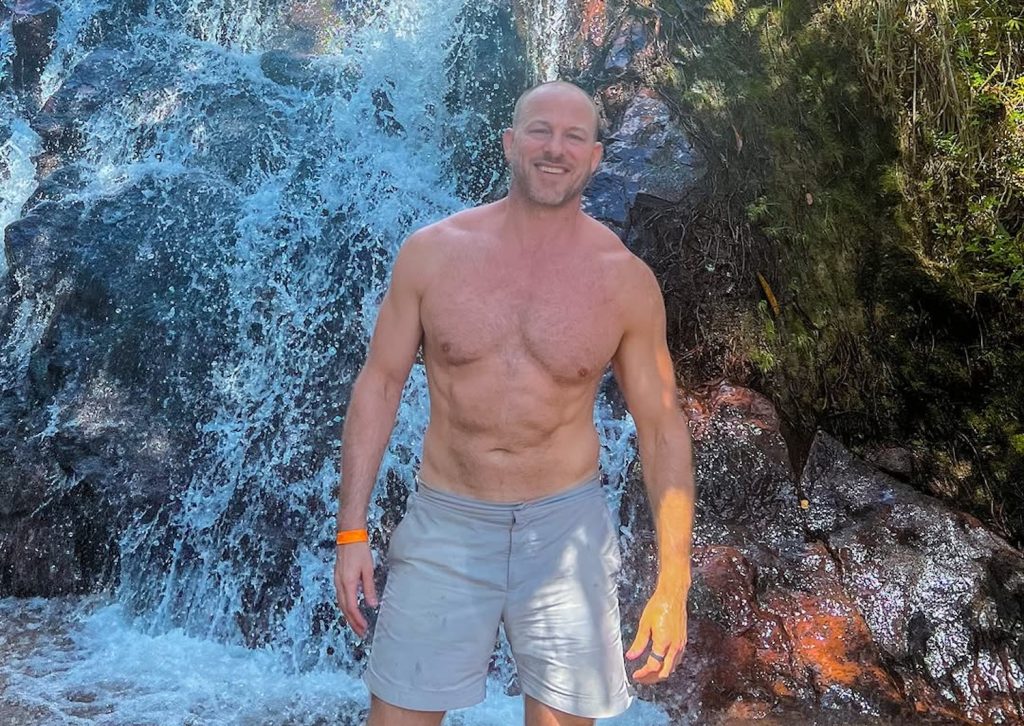
Today, a health and performance guru looks back with 20/20 hindsight. At 48, the same age as Bryan Johnson, Ted Ryce reflects on what he would do differently if he could start over in his 20s.
For those of us in the Don’t Die community, optimizing for healthspan, performance, and longevity means constantly learning from the best. While Bryan Johnson leads the charge with biomarker tracking and experimental protocols, we often look to other experts to help round out the picture, especially in areas like strength, mindset, and real-world behavior change.
Ted Ryce is one of those trusted voices. With over 25 years of experience coaching celebrities, entrepreneurs, and Fortune 500 leaders, including Robert Downey Jr. and Sir Richard Branson, Ted has dedicated his life to helping high achievers look and feel 10 years younger. His Metabolic Reset Sequence program is tailored to men over 40 and focuses on building energy, confidence, and physical resilience.
“If I were in my 20s again, I’d be excited as hell. There’s never been more opportunity (and less real competition) to win.” -Ted Ryce, Health Coach
18 Life Lessons from Ted Ryce at Age 48
Earlier today, Ted shared a list of 18 powerful lessons he wishes he had embraced in his 20s. While many are grounded in transformation and self-confidence, they also speak directly to the foundational principles of longevity and a high-functioning life.
#1 Limit alcohol.
It makes you more emotional, disrupts your sleep, and stops you from learning. Less alcohol = faster progress.

#2 Lift weights.
The easiest way to gain respect & status is to change your body. This will give you the confidence to make more money & meet women.

#3 Learn social skills.
I took improv acting and public speaking courses. As a result, I speak confidently to everyone. The better you communicate, the more friends & money you'll make.

#4 Never stop learning.
Choose books, courses and mentors over free content.

#5 Reframe failure.
It's not final. It's feedback and informs you on what you need to do differently.

#6 Avoid comparing yourself.
Social media has created an environment where it seems everyone except you is rich, jacked and in a great relationship. However, it's false. Stay focused.

#7 Life gets better.
It's a trap to think your 20s are your best years. They're not. Your life will continue to get better as you grow as a person.

#8 Not everyone will like you.
That's okay. Look for people with whom you align in values and lifestyle. The rest don't matter.

#9 Travel.
Experiencing different cultures will teach you skills you can't learn anywhere else, like adapting to different languages and customs.

#10 Take more risks.
Most people will die full of regret. Don't be one of them. Be bold and shoot your shot.

#11 Spend time with successful people.
Forget binging YouTube videos on success. Being around those who’ve done it teaches you more than any online content ever will.

#12 Stop watching porn.
It'll kill your drive and give you a false sense of accomplishment. Take action instead.

#13 Learn to say "No."
Respect your time and energy. People won't like it, but they'll have more respect for you.

#14 Study money.
Learn how to make it, invest it and save it. Avoid wasting it on buying new cars and things that lose value immediately.

#15 Take radical responsibility.
Bad things will happen to you in life. Instead of letting them become why you failed, let them be why you succeeded.

#16 Speed of implementation.
As soon as you learn something new, look to apply it immediately. Then learn from the results.

#17 Learn a martial art.
It builds confidence in a way that no other form of exercise can. And you'll learn to perform under pressure.

#18 Do hard things.
You build confidence by facing challenges. Not by affirmations or reading books. Learn act even if you're uncomfortable.
The Longevity Lens: Why These Lessons Matter
At first glance, some of these may feel like personal development advice more than health optimization. However, viewed through the lens of Don’t Die, almost every point above aligns with known factors that influence longevity, brain health, and quality of life:
- Limiting alcohol supports better sleep, lower inflammation, and improved cognitive health
- Strength training helps maintain muscle mass, metabolism, and bone density as we age
- Lifelong learning and reframing failure are linked to neuroplasticity and psychological resilience
- Social connection, travel, and aligned community contribute to emotional well-being and long-term happiness
- Taking risks, saying no, and embracing hard things all foster a sense of agency, which correlates with longevity and life satisfaction
Many of these habits, especially building strength, cutting alcohol, and controlling what enters your mind and body, directly echo principles from Bryan Johnson’s Blueprint. While Bryan may take a more data-driven and quantified approach, Ted brings real-world experience and wisdom from decades of coaching high achievers.
Final Thoughts
Ted Ryce’s advice to his 20-year-old self is packed with insight for anyone trying to optimize for a longer, better life. The message is simple: healthspan is shaped not just by cutting-edge science, but by consistent choices in how we move, think, connect, and act. Whether you’re following Don’t Die, Blueprint, or your own path to longevity, there’s real power in combining the biological with the behavioral.
If you’re in your 40s or 50s, there’s no reason to dwell on what you didn’t start sooner. The best time to take control of your health is now. Just look at Bryan Johnson, he began his journey in his 40s and may now be the healthiest person in the world. And if you’re in your 20s, this is your blueprint. Follow it, and your future self will be stronger, sharper, and deeply grateful.
🩺 Disclaimer
The content on I Won’t Die is for informational and educational purposes only. It is not a substitute for professional medical advice, diagnosis, or treatment. Always consult a qualified healthcare provider with any health concerns.
🚀 Get Started with Blueprint
Start optimizing your health today with $25 off your first order! Use our referral code to begin your Blueprint journey and take control of your longevity.
🏋️♂️ Track Your Sleep, Workouts & Recovery
Boost your performance and recovery with Whoop. Join with my referral link to get a free WHOOP 5.0 and one month free!
📲 Download the I Won’t Die App
Stay ahead with the latest news, updates, and insights. Download the I Won’t Die app now on the Apple App Store and Google Play!
📩 Contact Us
Have tips, photos, or questions? Want to collaborate? Reach out at [email protected] — we’d love to hear from you!
🔗 Stay Connected
Follow us on Don't Die, Facebook, X, Instagram, YouTube, and LinkedIn for Blueprint longevity and Bryan Johnson updates.
📬 Subscribe to I Won’t Die Newsletter
Get the latest longevity breakthroughs, Blueprint updates, and exclusive content straight to your inbox — sign up now!


Miscellaneous News
Download the New I Won’t Die App: Longevity News, Biohacking Insights, and Health Tools

A faster, rebuilt iPhone app for curated longevity news, Bryan Johnson and Blueprint commentary, biomarker insights, fitness, recovery, nutrition, and practical health optimization.
The new I Won’t Die iOS app is now available.
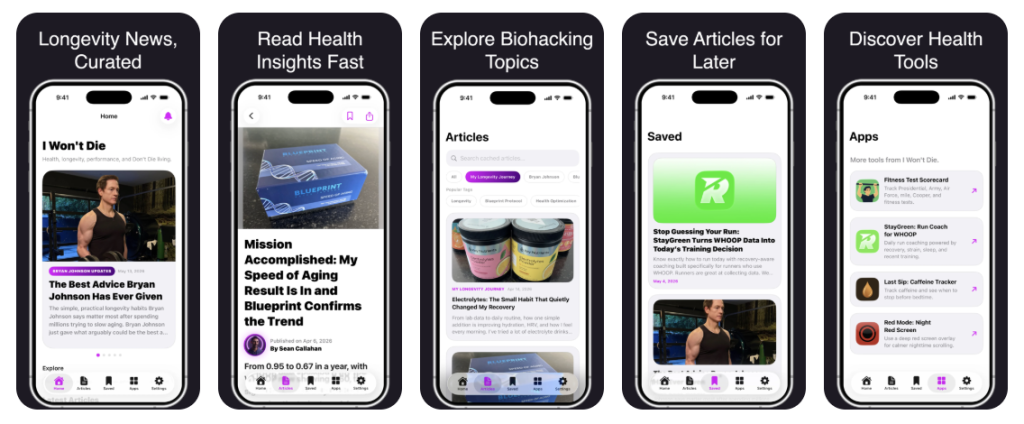
It has been rebuilt as a faster, fully native iPhone experience. The app helps you follow longevity news, biohacking insights, and practical health optimization.
Inside, you can read curated articles on healthspan, biomarkers, fitness, recovery, sleep, nutrition, and performance. Coverage also includes Bryan Johnson, Blueprint, the Blueprint protocol, and the Don’t Die movement.
This update brings a cleaner Home screen with featured articles, latest posts, topics, and health tools. Articles now open in a polished native reading view. You can save posts, share articles, explore related content, and open links more easily.
Image handling, article formatting, and overall performance have also been improved. You can also turn on push notifications for newly published articles.
The goal is simple: stay informed without the clutter. No noisy popups. No distractions. Just curated longevity and health content in a clean app built for light mode and dark mode.
Whether you follow Bryan Johnson and Blueprint, or simply care about better health, the app keeps things focused. It is built for curious readers, biohackers, fitness-minded people, and anyone working toward a healthier life.
Download the new iOS app here:
https://apps.apple.com/us/app/i-wont-die/id6745723273
The Android version is also available, with the new update coming later:
https://play.google.com/store/apps/details?id=appiwontdiecom.wpapp
🩺 Disclaimer
The content on I Won’t Die is for informational and educational purposes only. It is not a substitute for professional medical advice, diagnosis, or treatment. Always consult a qualified healthcare provider with any health concerns.
🚀 Get Started with Blueprint
Start optimizing your health today with $25 off your first order! Use our referral code to begin your Blueprint journey and take control of your longevity.
🏋️♂️ Track Your Sleep, Workouts & Recovery
Boost your performance and recovery with Whoop. Join with my referral link to get a free WHOOP 5.0 and one month free!
📲 Download the I Won’t Die App
Stay ahead with the latest news, updates, and insights. Download the I Won’t Die app now on the Apple App Store and Google Play!
📩 Contact Us
Have tips, photos, or questions? Want to collaborate? Reach out at [email protected] — we’d love to hear from you!
🔗 Stay Connected
Follow us on Don't Die, Facebook, X, Instagram, YouTube, and LinkedIn for Blueprint longevity and Bryan Johnson updates.
📬 Subscribe to I Won’t Die Newsletter
Get the latest longevity breakthroughs, Blueprint updates, and exclusive content straight to your inbox — sign up now!
Miscellaneous News
Stop Guessing Your Run: StayGreen Turns WHOOP Data Into Today’s Training Decision
Know exactly how to run today with recovery-aware coaching built specifically for runners who use WHOOP.
Runners are great at collecting data.
We have watches, heart-rate zones, recovery scores, sleep scores, strain targets, pace charts, weekly mileage, training plans, and enough graphs to make a NASA engineer feel seen. 🚀
I do it daily using multiple apps and with my WHOOP device.
But there is one question most runners still ask almost every day, including myself:
What should I actually do today?
That is exactly why I built StayGreen: Run Coach for WHOOP, a new iOS app designed specifically for runners who use WHOOP and want clearer, smarter, more actionable run guidance.
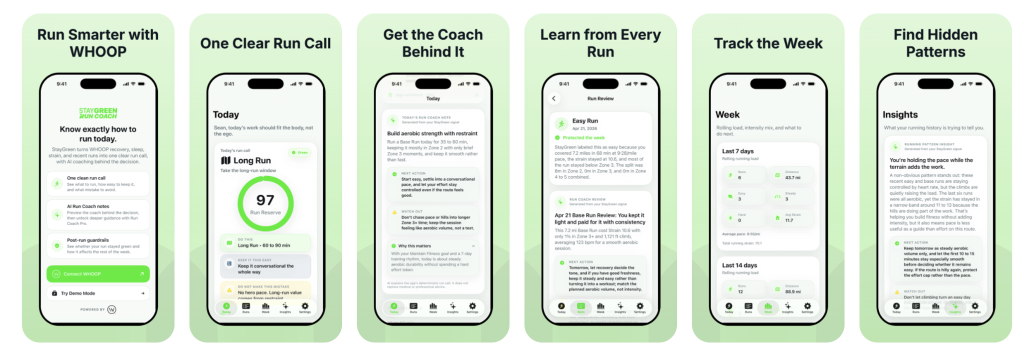
StayGreen takes your WHOOP recovery, sleep, strain, HRV, resting heart rate, physiological cycle data, and recent running history, then turns all of that signal into one focused daily run call.
Not a dashboard full of numbers, a vague “listen to your body,” or a general strain target.
A real running decision.
Should you run easy? Keep it aerobic? Move the long run? Take a recovery walk? Protect the week? Use today as a controlled quality window?
StayGreen is built to help you know in about five seconds.
Why StayGreen Exists
WHOOP gives runners powerful data. Recovery, strain, sleep, HRV, resting heart rate, workouts, and physiological trends can all tell you something important.
But runners do not just need more metrics.
They need translation.
Because a green recovery does not always mean “go crush yourself.” A yellow day does not always mean “do nothing.” A red day might not mean the week is ruined. And sometimes the smartest training move is not the hardest one, but the one that keeps tomorrow alive.
StayGreen sits on top of your WHOOP data and adds a running-specific coaching layer.
It looks at your baseline, your recent runs, your weekly load, your hard-effort spacing, your long-run timing, and the cost of your recent training. Then it answers the practical question runners care about most:
How should I run today?
The Daily Run Call
At the center of StayGreen is the Daily Run Call.
This is your simple, readable recommendation for the day. It brings together recovery, sleep, strain, HRV-informed readiness, recent running load, and your current running goal.
You might see guidance like:
- Run easy.
- Keep it aerobic.
- Move the long run.
- Take a recovery walk.
- Protect the week.
- Use today as a controlled quality window.
The goal is not to make every green day bigger. The goal is to train with better timing, better restraint, and better awareness of how today affects tomorrow.
That is the idea behind the name StayGreen. It is not about chasing green harder or turning every good recovery day into a test. It is about staying consistent, durable, and ready for the next run.
For me personally, that means longevity running: a daily seven-mile rhythm where the goal is not to empty the tank, but to finish feeling strong, recover well, and wake up ready to do it again.
Meet Run Reserve
StayGreen also introduces a simple score called Run Reserve.
Run Reserve helps answer: “How much running capacity do I have today?”
It is not just a recovery score. It is a running-readiness signal that considers your WHOOP data alongside recent training load, sleep, strain, and baseline trends.
A high Run Reserve might mean you have room to extend, build, or execute the plan.
A lower Run Reserve might mean the better move is to keep things easy, shorten the run, or protect the rest of the week.
It gives runners a practical way to understand capacity without needing to interpret every underlying metric manually.
The Coach Behind the Decision
StayGreen is free to download and includes core daily guidance, but runners who upgrade to Run Coach Pro unlock the AI coaching layer behind the decisions.
That is where the app gets even more useful.
Run Coach Pro adds AI-assisted coach notes that explain what to do, why it matters, and the mistake to avoid. Instead of only seeing the recommendation, you get the reasoning behind it.
For example, StayGreen might tell you that today is better suited for aerobic work because your weekly load is already climbing, your last hard effort is still recent, and your recovery is good enough to move but not ideal for forcing intensity.
That kind of context helps you train smarter, not just obey a score.
Post-Run Coaching That Actually Teaches You Something
A lot of running apps are built around what happened.
StayGreen is built around what it means.
After a run, StayGreen looks at the effort and helps you understand whether you protected the week, spent too much, or kept the run right where it needed to be.
It can identify when an easy run quietly turned into a workout, show when a run was controlled enough to support tomorrow, and help you understand what today’s effort may have cost your body and how it affects your next decision.
That is especially helpful for runners who love to push, because the line between “easy” and “accidentally spicy” can get blurry fast.
Weekly Coaching and Hidden Patterns
StayGreen is not only about today.
The app also helps you understand your week.
With Run Coach Pro, you can unlock weekly coach reads and running pattern insights that look at rolling load, intensity mix, long-run readiness, normal range, and trends that are easy to miss.
Maybe your base runs are getting smoother, while your easy days are quietly drifting too hard. Maybe your weekly load is climbing faster than your recovery can support, or the terrain, heat, hills, and pacing patterns are making certain runs more expensive than expected.
StayGreen helps surface those patterns so you can make better choices before your body has to send the message louder.
Built Around Your Goal
StayGreen adapts its recommendations based on what kind of runner you are trying to be right now.
You can use it for:
- Build Base
- Improve Speed
- 5K and 10K training
- Half Marathon training
- Marathon training
- Longevity Running
- Return to Running
- Maintain Fitness
Whether you are coming back carefully, building durability, chasing a race goal, or simply trying to run consistently without burning out, StayGreen helps interpret your WHOOP data through the lens of your actual running goal.
Free vs. Run Coach Pro
StayGreen is free to download.
The free version includes your daily WHOOP-powered run call, Run Reserve score, basic post-run recap, basic weekly load, and limited coach note previews.
Run Coach Pro unlocks the deeper coaching layer, including AI Run Coach Notes, Post-Run Coach Notes, Weekly Coach Reads, Running Pattern Insights, full history, long-run guidance, Training Cost, and regenerated coach notes.
So you can start with the simple daily decision, then upgrade when you want the coach behind the call.
Who StayGreen Is For
StayGreen is for runners who use WHOOP and want their recovery data to become more actionable.
Use it when you wake up wondering whether today should be easy or hard.
Bring it into your training when you are preparing for a 5K, 10K, half marathon, or marathon and want to avoid blindly stacking fatigue.
Rely on it when consistency matters more than hero workouts.
Open it when you love data, but really want decisions.
Most of all, StayGreen is for runners who want to train better with restraint, because the best run is not always the hardest run.
Sometimes the best run is the one that keeps the week alive.
Download StayGreen for iOS
StayGreen: Run Coach for WHOOP is available now for iPhone.
Download it here:
https://apps.apple.com/us/app/staygreen-run-coach-for-whoop/id6762893528
StayGreen is independent and not affiliated with, endorsed by, or sponsored by WHOOP.
🩺 Disclaimer
The content on I Won’t Die is for informational and educational purposes only. It is not a substitute for professional medical advice, diagnosis, or treatment. Always consult a qualified healthcare provider with any health concerns.
🚀 Get Started with Blueprint
Start optimizing your health today with $25 off your first order! Use our referral code to begin your Blueprint journey and take control of your longevity.
🏋️♂️ Track Your Sleep, Workouts & Recovery
Boost your performance and recovery with Whoop. Join with my referral link to get a free WHOOP 5.0 and one month free!
📲 Download the I Won’t Die App
Stay ahead with the latest news, updates, and insights. Download the I Won’t Die app now on the Apple App Store and Google Play!
📩 Contact Us
Have tips, photos, or questions? Want to collaborate? Reach out at [email protected] — we’d love to hear from you!
🔗 Stay Connected
Follow us on Don't Die, Facebook, X, Instagram, YouTube, and LinkedIn for Blueprint longevity and Bryan Johnson updates.
📬 Subscribe to I Won’t Die Newsletter
Get the latest longevity breakthroughs, Blueprint updates, and exclusive content straight to your inbox — sign up now!

America’s favorite celebration comes with a hidden cost and that is air pollution, brain damage, and toxic exposure that rivals chain smoking.
Today, we recover from celebrating America’s birthday with fireworks and from inhaling the consequences. Yes, we’re talking about air quality outdoors post celebration.
Every year on July 4th, skies across the United States explode with color. It’s a tradition rooted in pride, patriotism, and the pursuit of happiness. However, while we celebrate our freedom, our bodies quietly absorb the cost.
Bryan Johnson recently shared what that cost looks like. According to his air quality monitors, PM₂.₅ levels during fireworks reached 160 micrograms per cubic meter, the equivalent of smoking a full cigarette in just one evening. In some areas, the air was as toxic as smoking 20 cigarettes. That’s not just patriotic, it’s poisonous.
Fireworks and Fine Particulates
Fireworks release a cocktail of harmful pollutants, including particulate matter (PM₂.₅), heavy metals like strontium and barium, and ultrafine soot. PM₂.₅ is especially concerning because it’s small enough to enter your lungs, bloodstream, and even cross the blood–brain barrier, potentially impacting brain health.
According to the EPA and NIH, exposure to PM₂.₅ has been linked to:
- Increased risk of cardiovascular disease
- Declines in cognitive function
- Higher rates of depression and anxiety
- Disruption of immune and cancer surveillance systems
In other words, these celebrations aren’t just loud, they’re neurotoxic.
It Doesn’t Stop in the Sky
What goes up must come down. Firework residue settles into our soil and water, where it contaminates food sources and drinking water. These heavy metals and chemicals don’t vanish after the show. They linger, bioaccumulate, and eventually make their way into our bodies again through food and water.
Fireworks are also a major cause of wildlife stress, asthma flare-ups, and ER visits during holiday weekends. The environmental and public health burden is significant, but we Americans love our fireworks to celebrate our country’s birthday.
Your Home Is a Sanctuary, If You Treat It Like One
Bryan’s data also shows that air quality inside his home remained dramatically better than outside during the fireworks, thanks to airtight building design, air purifiers, and filtered HVAC systems. In contrast, most homes without filtration offer little protection. Outdoor toxins easily infiltrate through vents, windows, and poorly sealed walls.
You can reduce your exposure with:
- HEPA or carbon-based air purifiers
- Keeping windows closed on high-pollution days
- Monitoring air quality with tools like PurpleAir or IQAir
- Using filtered masks if outdoors during high PM events
Alcohol and the Holiday Hangover
Bryan also called out another July 4th staple: alcohol. While drinking might seem like part of the fun, it comes with its own list of problems:
- It impairs neurogenesis and cognitive function
- Weakens immune response and cancer surveillance
- Disrupts sleep cycles
- Increases risk of depression and brain inflammation
So while it may feel like “letting loose,” you’re actually doing more long-term damage than you might think. Plain and simple. Don’t drink alcohol.
Final Thoughts
Our traditions mean something. They connect us to history, to each other, and to a shared sense of identity. However, if we’re honest, some of these customs are outdated and damaging, especially when we have the data to prove it.
This isn’t about canceling fireworks or outlawing alcohol. It’s about being informed. If we can send rockets into the sky to dazzle the nation, we can also find ways to celebrate without poisoning the air, water, and ourselves. Maybe it’s time to embrace drone-only firework displays on the 4th of July!
Let’s find ways to celebrate freedom that don’t come at the cost of our health. The future deserves clean air, conscious choices, and the kind of optimism that builds smarter traditions. Can patriotism shine just as brightly without the explosions? Share your thoughts in the comments below. 🎆
🩺 Disclaimer
The content on I Won’t Die is for informational and educational purposes only. It is not a substitute for professional medical advice, diagnosis, or treatment. Always consult a qualified healthcare provider with any health concerns.
🚀 Get Started with Blueprint
Start optimizing your health today with $25 off your first order! Use our referral code to begin your Blueprint journey and take control of your longevity.
🏋️♂️ Track Your Sleep, Workouts & Recovery
Boost your performance and recovery with Whoop. Join with my referral link to get a free WHOOP 5.0 and one month free!
📲 Download the I Won’t Die App
Stay ahead with the latest news, updates, and insights. Download the I Won’t Die app now on the Apple App Store and Google Play!
📩 Contact Us
Have tips, photos, or questions? Want to collaborate? Reach out at [email protected] — we’d love to hear from you!
🔗 Stay Connected
Follow us on Don't Die, Facebook, X, Instagram, YouTube, and LinkedIn for Blueprint longevity and Bryan Johnson updates.
📬 Subscribe to I Won’t Die Newsletter
Get the latest longevity breakthroughs, Blueprint updates, and exclusive content straight to your inbox — sign up now!

The Foods That Help Me Eat Big and Stay 155 to 160 lbs

I’m Officially a Rejuvenation Olympian, Ranked #167 Behind Bryan Johnson

When More Exercise Stops Moving the Needle

I Took My Function Health Mid-Year Test: Now We Wait

Download the New I Won’t Die App: Longevity News, Biohacking Insights, and Health Tools

The Best Advice Bryan Johnson Has Ever Given

Stop Guessing Your Run: StayGreen Turns WHOOP Data Into Today’s Training Decision

Electrolytes: The Small Habit That Quietly Changed My Recovery

Mission Accomplished: My Speed of Aging Result Is In and Blueprint Confirms the Trend

Take Two: The Speed of Aging Redemption

Red Mode Is Live: Become a Professional Sleeper

Function Health January Labs: One Year Later

Blood, Biomarkers, and Beach Miles

Starting the Year Strong, Not From Scratch

How To Build Great Health One Boring Day at a Time

Bryan Johnson Shares Details of His HBOT Protocol for Longevity

Bryan Johnson Updates His Morning Routine Again: Here’s What’s New in May 2025

The Healthiest Lab Results Ever Recorded? Inside Bryan Johnson’s Longevity Bloodwork

Bryan Johnson Sat in a 200°F Sauna for 7 Days. Here’s What Changed

How Sauna Sessions Helped Bryan Johnson Eliminate 7 Harmful Toxins

How Strong Are Your Bones? Bryan Johnson’s Blueprint for Bone Health and Longevity

WHOOP MG Review: Improved Accuracy, New Features, and How WHOOP Age Compares to Blueprint’s Speed of Aging

Bryan Johnson’s 2025 Skincare Routine Revealed: How He Reversed His Skin Age by Decades

How Bryan Johnson Removed 93 Percent of Microplastics From His Blood

Inside Bryan Johnson’s 2025 Longevity Protocol and Why It Inspires Me

Don’t Die Podcast #3: Why Resting Heart Rate May Be the Most Powerful Health Metric for Sleep and Longevity

My Blueprint Advanced Panel Results: A Deep Dive into Longevity Biomarkers

The One Food Bryan Johnson Swears By for Longevity: Extra Virgin Olive Oil

How Bryan Johnson Gets Perfect Sleep Scores Every Night: A Blueprint for Deep Rest

Who Is the Healthiest Person in the World? This Man’s Data-Driven Life May Be the Answer
-

 Bryan Johnson Updates9 months ago
Bryan Johnson Has A Girlfriend: Finding The Person Who Feels Like Home And Why It Changes Everything
-
 My Longevity Journey10 months ago
WHOOP Advanced Labs: Understanding the Body Behind the Data
-

 Bryan Johnson Updates10 months ago
Sauna, Fertility, and Why This Matters More Than Ever
-
 My Longevity Journey11 months ago
How I Cut My ApoB by 51% Without Medication