Don't Die Updates
Don’t Die Episode #6: The Hidden Costs of High Performance and Fame with Dr. Mike Israetel

This candid episode unpacks the mental strain of fame, the illusion of money as happiness, and why trust breaks down at the top.
Today, Bryan Johnson sat down with Dr. Mike Israetel for one of the most unexpectedly therapeutic episodes of the Don’t Die Podcast. On the surface, this 1-hour long conversation was about productivity, creativity, and high performance. However, it quickly spiraled into something deeper.
Together, with regular co-hosts Kate Tolo and Dr. Mike Mallin, they explored the psychological labyrinth of wealth, fame, public scrutiny, and personal growth in a hyperconnected world. This wasn’t anything like an interview, rather a group therapy session disguised as a podcast. Below are the highlights in case you don’t have time to listen or watch the entire episode.
Flow States and the Art of Deep Work
The episode opened with a surprisingly tender appreciation for comfy chairs and curved monitors. Both Bryan and Mike emphasized how essential comfort and isolation are for achieving flow. Whether it’s a zero-gravity chair or a 50-inch curved screen, setting up your environment to reduce friction is a performance multiplier.
Planes also came up as surprising productivity sanctuaries. Bryan loves long flights for deep thought. Dr. Mike uses them to talk to ChatGPT. Both described an almost trance-like clarity at 30,000 feet. Add edibles, and you might even generate a few world-changing ideas, or at least some you can laugh at later.
Creativity Triggers and Idea Filtering
Dr. Mike broke down his creative process like a scientific method. He builds a mental “knowledge tree,” branches out ideas during free-form states (often while high or falling asleep), and then ruthlessly prunes them in sober, critical sessions. His biggest tip: never let an idea go unwritten. Write down everything. Sort it later.
Bryan’s take was equally introspective. For him, the best ideas come during sleep. Dream-state ideation isn’t just whimsical, it’s strategic. Creating space to think, whether while asleep or on a run, is essential to accessing real creativity.
The Burnout of Messaging Overload
Everyone on the episode agreed: the always-on nature of modern communication is suffocating. Hundreds of messages a day, spread across email, Instagram, Slack, and text, makes deep work feel impossible. Bryan revealed the sheer pressure he faces, from nation-state leaders to close friends, all expecting urgent responses.
The crew didn’t sugarcoat it. Fame and digital presence amplify the chaos. People assume access means availability. But more often than not, it leads to emotional exhaustion and boundary collapse.
Money Changes Everything, And Not Always for the Better
Bryan opened up about how money distorted nearly every close relationship he had. Half the people in his inner circle, he said, have stolen from him. That level of betrayal isn’t about bad people, he explained. It’s about how money bends incentives and blurs boundaries.
Dr. Mike echoed the sentiment. Fame and money warp reality. People smile because you’re successful, not because they like you. The solution? Clear expectations and preemptive boundaries in every new relationship.
Mallin added a different angle: being around wealthy people made him want less money. The emotional cost of managing relationships, trust, and constant suspicion wasn’t worth the perks.
Fame Doesn’t Come With Privacy
The most revealing part of the episode? The candid discussion about fame. Bryan described a recent flight where people formed a selfie line in the aisle, delaying boarding. Dr. Mike shared how walking the streets now feels different. No anonymity. No normalcy. Just being “Dr. Mike.”
The group agreed that fame is like money, but without the paycheck. It shifts how people see you. Suddenly, everything is a transaction, even if you just want to make a friend. This is sad to hear.
Cancel Culture, Criticism, and Emotional Armor
Bryan and Dr. Mike both spoke openly about the toll of public criticism. When you’re constantly being picked apart, it’s easy to feel misunderstood and even villainized. However, Bryan offered a powerful reframe: critiques are usually confessions. People project their pain. It’s not about you. It’s about them.
Instead of reacting in anger, Bryan leans into empathy. He sees most people as operating from pain, sleep deprivation, poor health, or stress. That lens of compassion helps him stay centered, even when online vitriol piles up.
Final Thoughts
What began as a conversation about performance quickly became something more human. This episode was a rare look at the emotional side of being “optimized.” Bryan, Dr. Mike, and the crew reminded us that no amount of money, fame, or productivity tools can replace the basics, which include good sleep, honest relationships, clear boundaries, and time to think.
High performance is only sustainable if you protect your mind and your circle. And sometimes, the strongest flex isn’t hustle. It’s stillness.
🩺 Disclaimer
The content on I Won’t Die is for informational and educational purposes only. It is not a substitute for professional medical advice, diagnosis, or treatment. Always consult a qualified healthcare provider with any health concerns.
🚀 Get Started with Blueprint
Start optimizing your health today with $25 off your first order! Use our referral code to begin your Blueprint journey and take control of your longevity.
🏋️♂️ Track Your Sleep, Workouts & Recovery
Boost your performance and recovery with Whoop. Join with my referral link to get a free WHOOP 5.0 and one month free!
📲 Download the I Won’t Die App
Stay ahead with the latest news, updates, and insights. Download the I Won’t Die app now on the Apple App Store and Google Play!
📩 Contact Us
Have tips, photos, or questions? Want to collaborate? Reach out at [email protected] — we’d love to hear from you!
🔗 Stay Connected
Follow us on Don't Die, Facebook, X, Instagram, YouTube, and LinkedIn for Blueprint longevity and Bryan Johnson updates.
📬 Subscribe to I Won’t Die Newsletter
Get the latest longevity breakthroughs, Blueprint updates, and exclusive content straight to your inbox — sign up now!


Deep red night screen in one tap, plus Autopilot scheduling that makes it set-and-forget.
Today, I shipped a new iPhone app today called Red Mode.
It’s built for one thing: making it ridiculously easy to get a deep red screen at night, on demand or automatically, without turning your evening into a settings scavenger hunt.
If you’ve been following Bryan Johnson’s longevity work, you’ve probably heard him talk about becoming a professional sleeper. That phrase stuck with me because it’s not about hacks, it’s about building a simple routine you can actually stick to.
Red Mode is my tiny contribution to that idea.
Why I Built It
A lot of people want the benefits of a night friendly screen, but the setup friction is real. iOS can do deep red with Color Filters, and Shortcuts can automate it, but most people never bother because it feels like a hassle.
So I built Red Mode to make the whole thing feel like a product:
- clear setup steps
- one tap actions
- a simple Autopilot schedule
- a clean Wind Down button for nights when you just want it now
The goal is not perfection. The goal is consistency.
What Red Mode Does
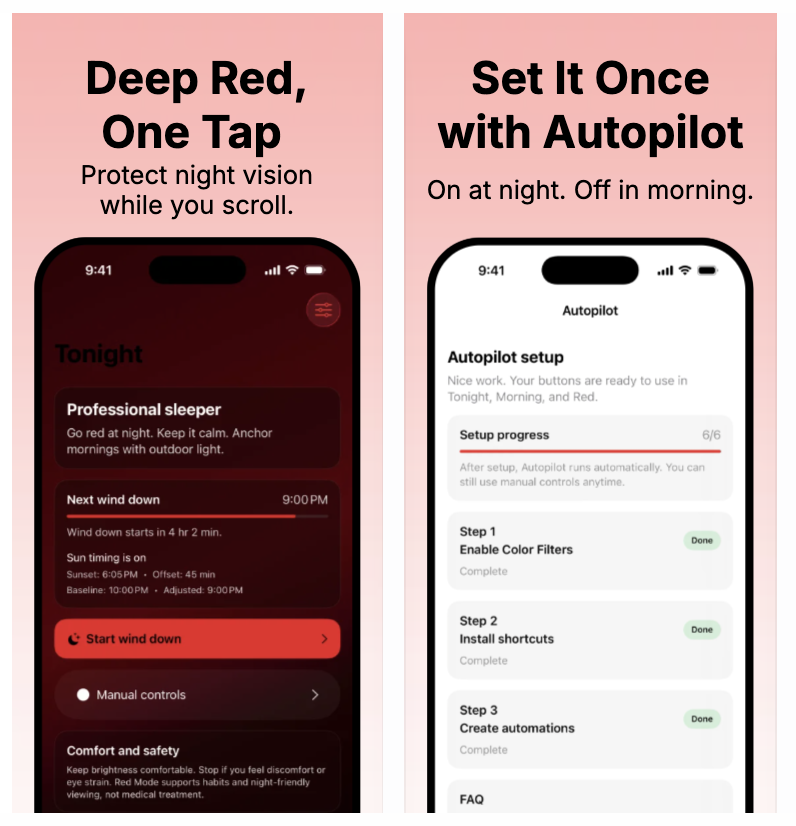
Deep Red, One Tap
If you scroll in bed, check your phone in a dark room, or just want a calmer screen at night, this is the main event.
Tap once and your screen goes deep red.
Set It Once with Autopilot
This is the feature I recommend for almost everyone.
Autopilot turns Red Mode on at night and off in the morning. It’s genuinely set-and-forget once you enable it.
Setup is intentionally fast. Installing the included Shortcuts and creating the automations takes about 2 minutes if you follow the steps.
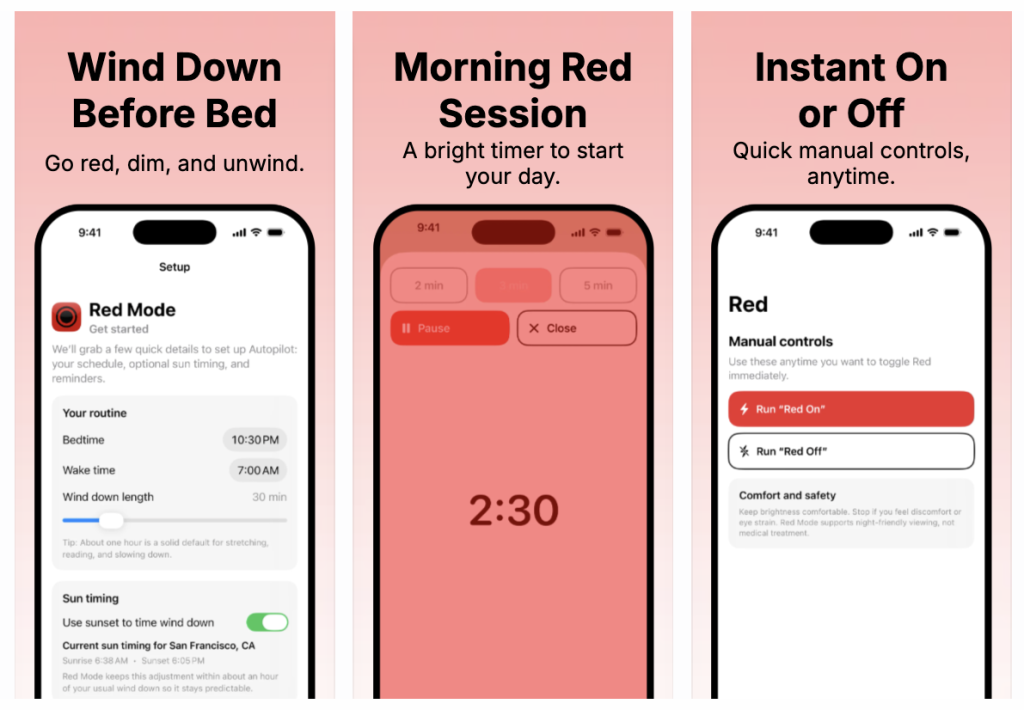
Wind Down Before Bed
Wind Down is for the nights you want an immediate reset.
Use it when:
- you did not set up Autopilot yet
- you are traveling or your schedule is different
- you want a quick, intentional “I’m done for the night” moment
If you do not set up Autopilot, Wind Down is what you will run each night.
If you do set up Autopilot, Wind Down becomes optional, like a manual override.
Morning Red Session
This one is different and very intentional.
Morning Red Session is a bright, timed red screen you can run in the morning. It’s built to support a simple routine with a timer, without overthinking it.
Instant On or Off
You can always toggle red on or off anytime. No ceremony, no digging.
Who It’s For
- bedtime scrollers who want a calmer screen at night
- parents checking a phone in a dark room
- night shift users
- stargazers and anyone protecting dark adaptation
- photographers and darkroom folks who want red light options
- anyone trying to build better sleep habits and a consistent evening routine
Design Notes
I thought a lot about keeping the design quiet and obvious. The app should feel like it belongs on your phone, not like a gadget.
It was a fun project to build, and I hope it’s genuinely useful for anyone who cares about sleep, routines, and longevity.
Price
Red Mode is a $0.99 one-time purchase. No subscription.
Download
You can grab it here:
https://apps.apple.com/us/app/red-mode-red-screen-night/id6759926783
If you try it, I’d love your feedback. And if you find it useful, a quick App Store review really helps.
🩺 Disclaimer
The content on I Won’t Die is for informational and educational purposes only. It is not a substitute for professional medical advice, diagnosis, or treatment. Always consult a qualified healthcare provider with any health concerns.
🚀 Get Started with Blueprint
Start optimizing your health today with $25 off your first order! Use our referral code to begin your Blueprint journey and take control of your longevity.
🏋️♂️ Track Your Sleep, Workouts & Recovery
Boost your performance and recovery with Whoop. Join with my referral link to get a free WHOOP 5.0 and one month free!
📲 Download the I Won’t Die App
Stay ahead with the latest news, updates, and insights. Download the I Won’t Die app now on the Apple App Store and Google Play!
📩 Contact Us
Have tips, photos, or questions? Want to collaborate? Reach out at [email protected] — we’d love to hear from you!
🔗 Stay Connected
Follow us on Don't Die, Facebook, X, Instagram, YouTube, and LinkedIn for Blueprint longevity and Bryan Johnson updates.
📬 Subscribe to I Won’t Die Newsletter
Get the latest longevity breakthroughs, Blueprint updates, and exclusive content straight to your inbox — sign up now!

Bryan Johnson shares his personal protocol for mastering sleep, backed by data, wearables, and years of experimentation.
Today, sleep isn’t just rest. It’s a skill you can master. Bryan Johnson calls it the greatest performance enhancing drug on Earth. Not a supplement or a superfood, but something you already do or should do every night.
In his latest video podcast episode, Bryan lays out the advanced sleep system he used to get eight consecutive months of perfect sleep. This isn’t a gimmick or another top 10 list. It’s a personal science experiment, honed by data and habit, that anyone can learn from.
Let’s break down what makes his protocol different and how you can apply it to your life.
Why Sleep Matters More Than You Think
Bryan makes it clear: sleep isn’t just a pillar of health, it’s the foundation. It influences your mood, your memory, your relationships, even your earning potential. And yet, most people treat sleep as optional, sacrificing it for work, social events, or binge watching stressful TV shows.
His point is simple: you wouldn’t show up late to a work meeting, so why show up late to your own bedtime?
Resting Heart Rate is Your Sleep Report Card
The secret weapon of Bryan’s sleep mastery is his resting heart rate before bed. Unlike typical wearables that track heart rate during sleep, Bryan focuses on what it’s doing right before his head hits the pillow.
If your heart rate is low at that moment, you’re primed for a great night. If it’s high, you’re headed for poor recovery. Food, stress, screens, arguments, anything that raises heart rate before bed is the enemy.
He uses this single metric to simplify the chaos of health and behavior. It’s the north star of his evening routine.
Food is the Number One Sleep Killer
According to Bryan and his team, nothing wrecks sleep like eating too close to bedtime, even if the food is “healthy.” Digestion activates the nervous system and raises heart rate. In Bryan’s case, even hummus and vegetables at the wrong time led to poor sleep data.
The takeaway: finish your final meal at least four hours before bed. For best results, aim for six to eight.
Become a Professional Sleeper
One of the most useful mindset shifts Bryan promotes is treating sleep like a job. Schedule it. Protect it. Track it. Improve it.
Here are his 10 essential tips for achieving elite sleep:
- Adopt a professional mindset – Sleep is your job.
- Stop eating early – Final meal 4 to 8 hours before bed.
- Start a wind down routine – 30 to 60 minutes of screen free calm.
- Use light to reset your clock – Get morning light or use a 10,000 lux lamp.
- Stick to a bedtime – Same time every night, ideally within a few minutes.
- Avoid caffeine late in the day – Its half life can destroy sleep quality.
- Eliminate blue light – Use red or amber lighting in the evening.
- Cool your room – 69 to 71°F is optimal.
- Control noise – Use sound machines or earplugs if needed.
- Track your data – Wearables help create powerful sleep habits.
Bonus Tips That Make a Big Difference
The team added a few more actionable strategies:
- Move your phone away from your bed to reduce the temptation to scroll.
- Try journaling before bed to unload mental clutter or anxiety.
- Use your bed only for sleep and sex to train your brain for rest.
- Sleep separately from your partner if necessary and if possible for higher quality rest.
These are the habits that support a long life, strong mind, and healthy body.
Final Thoughts
There’s no magic pill for better sleep. But there is a repeatable protocol, tested by Bryan and fine tuned with real data, that can help you get there. If you’re tired of feeling tired, his approach offers something powerful: control.
Track your heart rate. Experiment with your evening routine. Make one small change today. And most of all, treat sleep with the seriousness it deserves.
If you want to live longer, think sharper, and feel your best, it all starts with sleep. Got a sleep tip that works for you? Share it in the comments below.
🩺 Disclaimer
The content on I Won’t Die is for informational and educational purposes only. It is not a substitute for professional medical advice, diagnosis, or treatment. Always consult a qualified healthcare provider with any health concerns.
🚀 Get Started with Blueprint
Start optimizing your health today with $25 off your first order! Use our referral code to begin your Blueprint journey and take control of your longevity.
🏋️♂️ Track Your Sleep, Workouts & Recovery
Boost your performance and recovery with Whoop. Join with my referral link to get a free WHOOP 5.0 and one month free!
📲 Download the I Won’t Die App
Stay ahead with the latest news, updates, and insights. Download the I Won’t Die app now on the Apple App Store and Google Play!
📩 Contact Us
Have tips, photos, or questions? Want to collaborate? Reach out at [email protected] — we’d love to hear from you!
🔗 Stay Connected
Follow us on Don't Die, Facebook, X, Instagram, YouTube, and LinkedIn for Blueprint longevity and Bryan Johnson updates.
📬 Subscribe to I Won’t Die Newsletter
Get the latest longevity breakthroughs, Blueprint updates, and exclusive content straight to your inbox — sign up now!
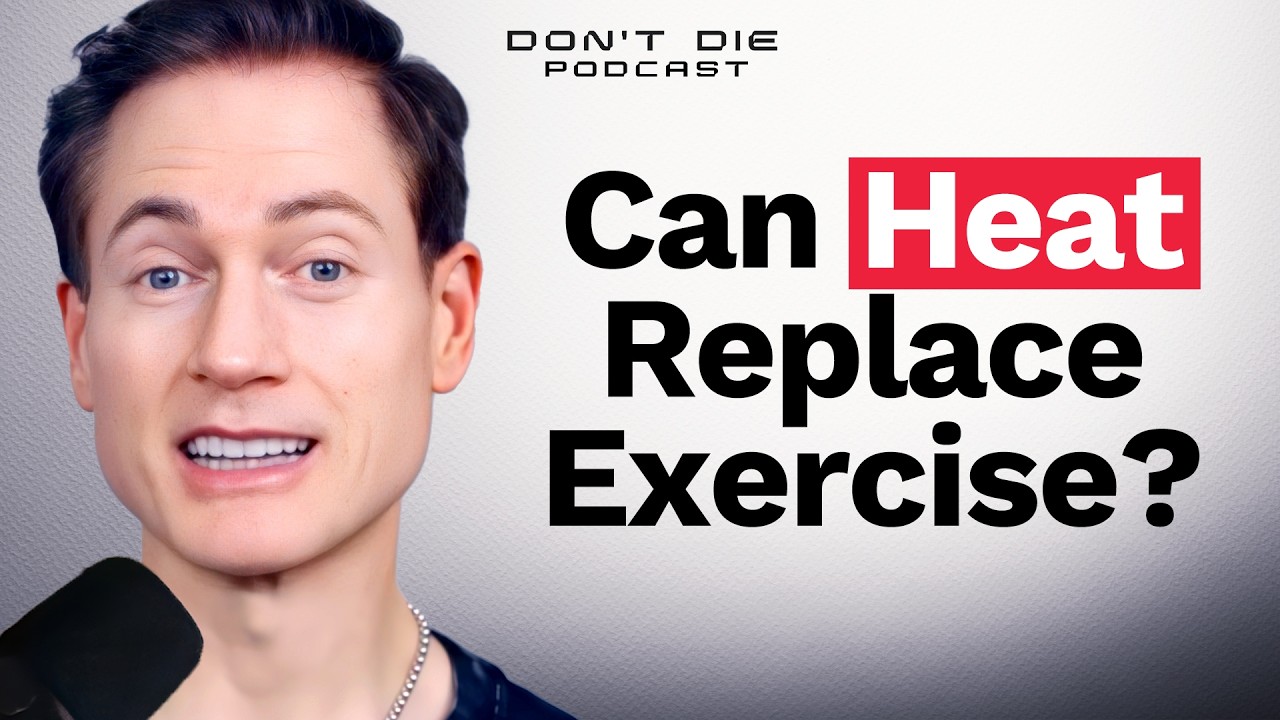
This episode explores how daily 200°F sauna sessions led to major improvements in blood pressure, detoxification, and cellular health in just three weeks.
Today, we explore how 20 minutes a day in a 200°F dry sauna impacted Bryan Johnson’s body and biomarkers.
In Don’t Die Podcast #7, Bryan Johnson shares results from his latest self-experiment: a 21-day high-heat sauna protocol. While most people use a sauna to relax, Johnson’s team treated it like a clinical trial, tracking blood pressure, inflammation, mitochondrial health, and toxin excretion.
The results? Bryan and his team discuss measurable improvements in cardiovascular markers, potential reductions in toxin levels, and elevated heat shock proteins that play a role in cellular repair and longevity. The experience, however, was far from easy and required ice packs on his head and testicles to endure the heat.
Why sauna? The science behind the sweat
Research from Finland and other countries shows sauna use is associated with:
- 50 to 70 percent lower risk of cardiovascular disease
- 40 percent reduction in all-cause mortality
- Reduced dementia and Alzheimer’s risk
Most of these benefits are tied to heat stress, not just sweating. The body responds by increasing nitric oxide, dilating blood vessels, boosting circulation, and mimicking some of the effects of cardiovascular exercise. It also activates heat shock proteins, which repair damaged proteins and reduce inflammation.
Mimicking exercise without moving
Sauna exposure raises heart rate and mimics light aerobic activity like zone one cardio. It’s an “exercise mimetic,” producing cardiovascular effects without physical movement. Bryan saw:
- A 5.8 percent drop in central systolic blood pressure
- A 21 percent improvement in aortic flexibility
- A decrease in arterial stiffness based on augmentation index
These changes came after just 7 sessions and were maintained through 18 to 21 sessions, suggesting sauna is a fast-acting tool for vascular health.
The detox protocol and early biomarker shifts
Bryan and his team tracked 100+ biomarkers including inflammation (CRP), growth hormone, cortisol, vascular age, and mitochondrial function. Highlights included:
- CRP dropped approximately 30 percent
- Blood flow visibly improved during blood draws
- Bryan’s vascular age decreased from 29 to early 20s
Although not all markers changed (his baseline was already elite), the sauna appeared to boost the body’s ability to detox. They expect to see drops in heavy metals, phthalates, and persistent organic pollutants in upcoming urine toxin panels.
Icing testicles, sleepless nights, and cramping
This wasn’t a spa day. For the first two weeks, Bryan felt exhausted, had disrupted sleep, and suffered intense cramps due to electrolyte loss. To mitigate the effects:
- He used ice packs on his head and genitals
- He added 600–700 mg sodium, plus potassium and magnesium, post-sauna
- He wore cotton clothing to avoid plastic toxins
- He shifted his sauna timing away from bedtime to improve sleep
He also avoided pouring water on sauna rocks, due to concerns over toxins in tap water becoming airborne in steam.
Dry vs. wet sauna and how to replicate the protocol at home
Bryan’s team chose a dry Finnish-style sauna at 200°F with 10–20 percent humidity. This style has the strongest research backing. Wet or infrared saunas can still provide benefit, but often don’t reach therapeutic heat levels.
His at-home protocol is:
- 20 minutes at 200°F
- Every day or nearly every day
- Ice packs on sensitive areas
- Electrolyte hydration before and after
- Immediate shower after to wash off toxins
Anyone can start this protocol with modifications. The key is to ease in slowly. Start with 140°F, limit sessions to 2 to 3 per week, and gradually build up.
Who should avoid sauna use?
Bryan’s team flagged several populations who should proceed with caution:
- Pregnant individuals
- People with unmanaged cardiovascular conditions
- Those with electrolyte disorders or dizziness-prone conditions like POTS
Always consult a physician before starting an intense heat therapy protocol.
Sauna and the broader longevity mission
Bryan frames his sauna protocol as more than health optimization. It is part of a broader movement to reduce death in all its forms and extend human potential. The Don’t Die mission is to reject default aging and experiment with new systems of living that improve vitality, brain function, and emotional wellbeing.
Final Thoughts
Bryan Johnson’s sauna protocol isn’t for the faint of heart, but the early results are compelling. From a drop in blood pressure to signs of toxin elimination and increased heat shock protein activity, 20-minute dry sauna sessions may offer one of the simplest, most accessible longevity interventions available today. Whether you’re optimizing for cardiovascular health, brain performance, or detoxification, sauna might be your next great protocol.
🩺 Disclaimer
The content on I Won’t Die is for informational and educational purposes only. It is not a substitute for professional medical advice, diagnosis, or treatment. Always consult a qualified healthcare provider with any health concerns.
🚀 Get Started with Blueprint
Start optimizing your health today with $25 off your first order! Use our referral code to begin your Blueprint journey and take control of your longevity.
🏋️♂️ Track Your Sleep, Workouts & Recovery
Boost your performance and recovery with Whoop. Join with my referral link to get a free WHOOP 5.0 and one month free!
📲 Download the I Won’t Die App
Stay ahead with the latest news, updates, and insights. Download the I Won’t Die app now on the Apple App Store and Google Play!
📩 Contact Us
Have tips, photos, or questions? Want to collaborate? Reach out at [email protected] — we’d love to hear from you!
🔗 Stay Connected
Follow us on Don't Die, Facebook, X, Instagram, YouTube, and LinkedIn for Blueprint longevity and Bryan Johnson updates.
📬 Subscribe to I Won’t Die Newsletter
Get the latest longevity breakthroughs, Blueprint updates, and exclusive content straight to your inbox — sign up now!

The Foods That Help Me Eat Big and Stay 155 to 160 lbs

I’m Officially a Rejuvenation Olympian, Ranked #167 Behind Bryan Johnson

When More Exercise Stops Moving the Needle

I Took My Function Health Mid-Year Test: Now We Wait

Download the New I Won’t Die App: Longevity News, Biohacking Insights, and Health Tools

The Best Advice Bryan Johnson Has Ever Given

Stop Guessing Your Run: StayGreen Turns WHOOP Data Into Today’s Training Decision

Electrolytes: The Small Habit That Quietly Changed My Recovery

Mission Accomplished: My Speed of Aging Result Is In and Blueprint Confirms the Trend

Take Two: The Speed of Aging Redemption

Red Mode Is Live: Become a Professional Sleeper

Function Health January Labs: One Year Later

Blood, Biomarkers, and Beach Miles

Starting the Year Strong, Not From Scratch

How To Build Great Health One Boring Day at a Time

Bryan Johnson Shares Details of His HBOT Protocol for Longevity

Bryan Johnson Updates His Morning Routine Again: Here’s What’s New in May 2025

The Healthiest Lab Results Ever Recorded? Inside Bryan Johnson’s Longevity Bloodwork

Bryan Johnson Sat in a 200°F Sauna for 7 Days. Here’s What Changed

How Sauna Sessions Helped Bryan Johnson Eliminate 7 Harmful Toxins

How Strong Are Your Bones? Bryan Johnson’s Blueprint for Bone Health and Longevity

WHOOP MG Review: Improved Accuracy, New Features, and How WHOOP Age Compares to Blueprint’s Speed of Aging

Bryan Johnson’s 2025 Skincare Routine Revealed: How He Reversed His Skin Age by Decades

How Bryan Johnson Removed 93 Percent of Microplastics From His Blood

Don’t Die Podcast #3: Why Resting Heart Rate May Be the Most Powerful Health Metric for Sleep and Longevity

Inside Bryan Johnson’s 2025 Longevity Protocol and Why It Inspires Me

My Blueprint Advanced Panel Results: A Deep Dive into Longevity Biomarkers

How Bryan Johnson Gets Perfect Sleep Scores Every Night: A Blueprint for Deep Rest

The One Food Bryan Johnson Swears By for Longevity: Extra Virgin Olive Oil

My First Month with WHOOP: What I Learned About Sleep, Strain, and Recovery
-
 My Longevity Journey9 months ago
WHOOP Advanced Labs: Understanding the Body Behind the Data
-

 Bryan Johnson Updates8 months ago
Bryan Johnson Has A Girlfriend: Finding The Person Who Feels Like Home And Why It Changes Everything
-

 Bryan Johnson Updates9 months ago
Sauna, Fertility, and Why This Matters More Than Ever
-
 My Longevity Journey10 months ago
How I Cut My ApoB by 51% Without Medication